


Green Data Center & Energy
As a corporate technology partner we make data centre energy efficiency measurable through PUE baselining, cooling modernisation and renewable energy integration; gains are validated by measurement and reporting.
We make energy, infrastructure, and data management measurable for ESG goals; green-IT practices optimize cost and sustainability targets together.
Single partner and 360° coverage; security, continuity, and compliance decisions stay anchored to service-catalog scope.
12 service families integrated under one contract. No multi-vendor sprawl, broken SLAs, or responsibility gaps.
KVKK Article 9 and sector-specific data residency. Local data center options plus sovereign cloud deployment.
Monitoring, backup, and response design are aligned in one operating plan; commitments open through registered scope.
KVKK, ISO, and sector controls are considered from the first architecture pass; evidence is managed through registered records.
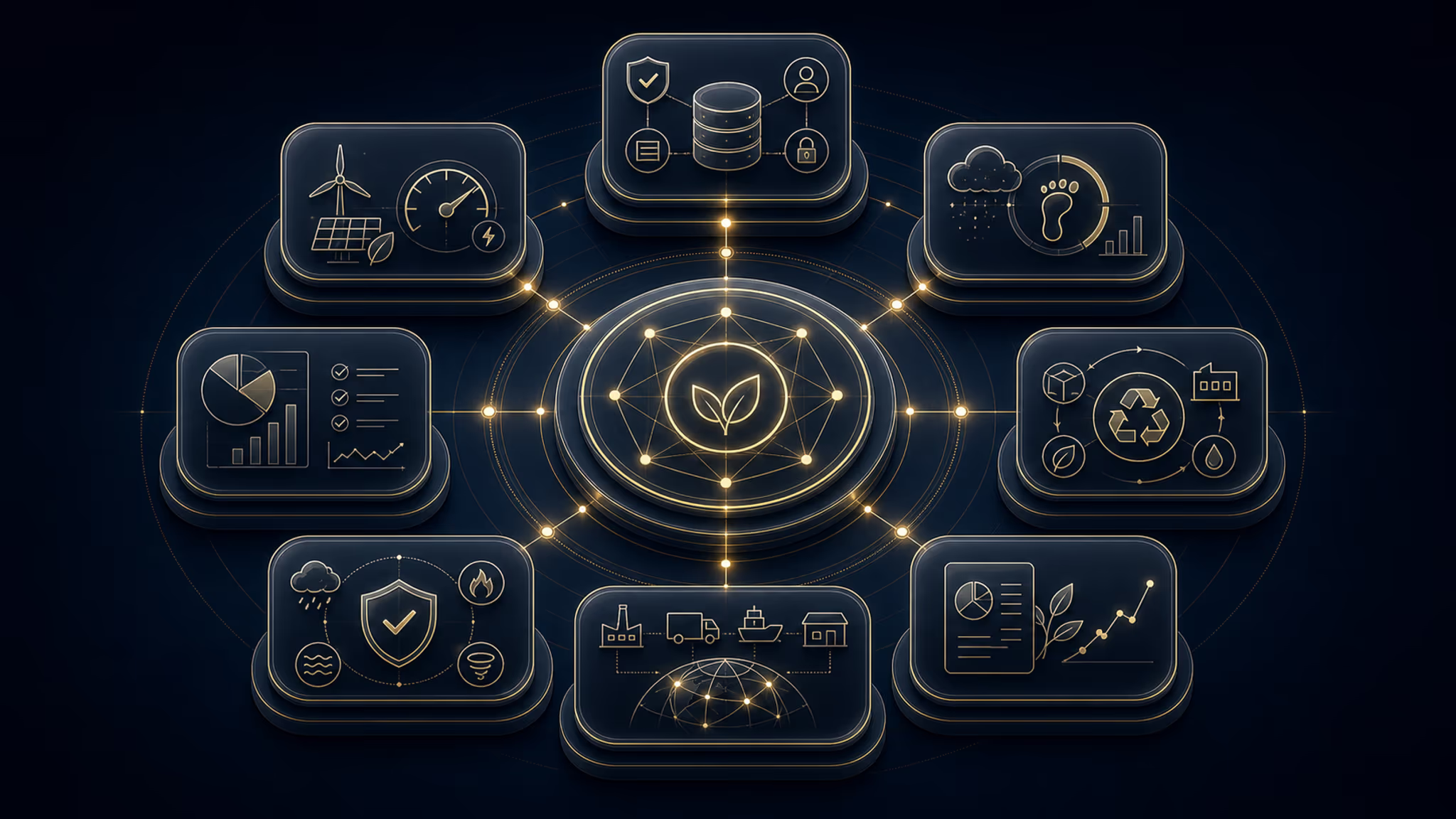
Sustainability & ESG Technologies gives teams a structured execution model for issues such as ESG data is scattered across disconnected sources, Carbon and energy metrics are hard to measure, and Reporting standards are difficult to satisfy, turning diffuse pressure into a measurable delivery track.
Green IT, carbon footprint, and social sustainability. Typical scope includes Green Data Center & Energy, Carbon Footprint Reporting, and Sustainable IT Strategy, with an emphasis on operational outcomes rather than isolated advisory output.
Claim ESG data is scattered across disconnected sources
Source Section Sustainability & ESG Technologies
Claim Carbon and energy metrics are hard to measure
Source Section Sustainability & ESG Technologies
Claim As a corporate technology partner we make data centre energy efficiency measurable through PUE baselining, cooling modernisation and renewable energy integration; gains are validated by measurement and reporting.
Source Section Green Data Center & Energy
Claim As a corporate technology partner we calculate Scope 1, 2 and 3 emissions under the GHG Protocol and ISO 14064; we supply data for ESG reporting (GRI, CDP, TCFD) and run the reduction strategy against measurement targets.
Source Section Carbon Footprint Reporting
Green IT, carbon footprint, and social sustainability.
Compare the workstreams, detail blocks, and question-and-answer surfaces under this pillar at a glance.
As a corporate technology partner we make data centre energy efficiency measurable through PUE baselining, cooling modernisation and renewable energy integration; gains are validated by measurement and reporting.
As a corporate technology partner we calculate Scope 1, 2 and 3 emissions under the GHG Protocol and ISO 14064; we supply data for ESG reporting (GRI, CDP, TCFD) and run the reduction strategy against measurement targets.
As a corporate technology partner we extend hardware life cycles with circular-economy principles; we institutionalise e-waste management through ITAD and accredited recycling and measurably reduce the environmental impact of IT operations.
As a corporate technology partner we establish a digital ethics framework and make technology's social impact measurable through AI bias assessment and DEI programmes; we strengthen the Social (S) dimension of ESG with an evidence file.
As a corporate technology partner we trace product and raw-material origin digitally; we establish supply-chain transparency with QR/RFID and optional blockchain and operate an ESG-aligned traceability system.
The following standards form the operational and audit baseline for this service pillar. Compliance is an architectural invariant, not just a requirement.
Environmental management system; ESG measurement references this standard.
ESG reporting standards; environmental + social + governance measurement.
Each sector uses this capability through different infrastructure, compliance, and operating priorities; the cards surface related services from the sector pages.
Student and staff personal data, MEB e-Okul and YÖK integrations, and remote-learning, LMS and exam platforms each carry their own access-security and data-integrity demands. Disk Hastanesi is the B2B/B2G corporate technology partner that builds that infrastructure for education organizations — aligned to KVKK, MEB/YÖK requirements and ISO 27001.
SCADA/OT environments across electricity distribution, generation, gas and renewable facilities operate under EPDK Information Security Regulation, NIS2, IEC 62443 and ISO 27019. Disk Hastanesi is the B2B/B2G corporate technology partner that builds the OT/IT-convergence security, continuity and data-governance infrastructure those critical-infrastructure operations depend on.
Banking operations run under continuous audit, high-availability demands, and BDDK Information Systems, DORA and PCI-DSS obligations. Disk Hastanesi is the B2B corporate technology partner that builds the transaction-integrity, fraud-management and operational-resilience infrastructure financial institutions rely on.
Multi-site project work, BIM and project data, tender and contract confidentiality, and occupational health and safety (OHS) records each demand secure, auditable handling under KVKK and ISO 27001. Disk Hastanesi is the B2B corporate technology partner that builds that infrastructure for construction and real estate organizations.
Open sector viewe-Government integrations, inter-agency data sharing and classified systems must align to the Presidency Digital Transformation Office Information and Communication Security Guide and KVKK. Disk Hastanesi is the B2G corporate technology partner that builds the information-security, critical-infrastructure-protection and continuity infrastructure public-sector organizations need.
WMS/TMS systems, IoT fleet and sensor telemetry, and customs and e-waybill integrations intersect across logistics operations that must stay traceable and auditable under ISO 28000 supply-chain security and KVKK. Disk Hastanesi is the B2B corporate technology partner that builds that infrastructure for logistics and supply-chain organizations.
Broadcast continuity, content-delivery performance and digital-archive integrity sit under RTÜK and Law No. 6112, FSEK No. 5846 content-rights law, KVKK viewer and subscriber duties, and — for cross-border operations — the GDPR and the EU Copyright Directive. Disk Hastanesi is the B2B corporate technology partner that builds that infrastructure for media and broadcasting organizations.
Open sector viewOmnichannel inventory accuracy, platform resilience under campaign peaks, and customer-data integrity must hold under PCI-DSS card-data rules, KVKK and GDPR, and Turkish Consumer Law and distance-selling regulations. Disk Hastanesi is the B2B corporate technology partner that builds that infrastructure for retail and e-commerce organizations.
Patient data is processed as KVKK special-category data while HIS, LIS, PACS and EHR systems run alongside Sağlık.NET, e-Nabız and MHRS integrations. Disk Hastanesi is the B2B corporate technology partner that builds the data-integrity and clinical-workflow continuity infrastructure healthcare organizations depend on.
Classified information, isolated networks and sensitive R&D data demand strict traceability and data integrity. Disk Hastanesi is the B2B corporate technology partner that builds that infrastructure for defense-industry organizations.
Open sector viewActuarial and claims data, policy administration and distribution channels must hold transaction accuracy and data integrity under SEDDK oversight, KVKK special-category data requirements, and high-availability expectations. Disk Hastanesi is the B2B corporate technology partner that builds that infrastructure for insurance organizations.
Subscriber traffic and location data are processed under KVKK while BSS/OSS, core network and 5G infrastructure run under BTK regulations and the data-retention obligations of Electronic Communications Law No. 5809. Disk Hastanesi is the B2B corporate technology partner that builds the service-continuity and data-integrity infrastructure telecommunications organizations rely on.
Multi-property operations face seasonal traffic swings, reservation and PMS continuity, payment security and guest-data privacy. Disk Hastanesi is the B2B corporate technology partner that builds the payment-security and data-integrity infrastructure tourism and hospitality organizations depend on.
IT/OT convergence, network segmentation and data integrity across MES, SCADA and production-line environments must align to IEC 62443, ISO 27001, GDPR and the EU NIS2 framework. Disk Hastanesi is the B2B corporate technology partner that builds that infrastructure for manufacturing and industrial organizations.
Timeline is confirmed during discovery based on scope, integration complexity, current maturity, and acceptance criteria. The project plan is tied to approved scope and dependencies.
For IT-intensive organizations, the most material Scope 3 categories are typically Category 1 (purchased goods and services, including cloud and SaaS), Category 11 (use of sold products, including software and hardware energy consumption), and Category 3 (fuel and energy-related activities not in Scope 1/2). We conduct a materiality screening in the first phase of engagement using revenue weighting and industry benchmarks to prioritize data collection effort.
Enterprise-grade servers and networking equipment have a manufacturer-defined useful life window, but with structured preventive maintenance, firmware management, and targeted component replacement, operational life can be extended when condition, supportability, and risk assessments allow. For end-user devices, refurbishment programs typically extend laptop lifecycles beyond the standard refresh cycle when supportability allows, reducing procurement volume and associated Scope 3 Category 2 emissions against the agreed baseline.
The EU AI Act classifies AI systems into risk tiers: unacceptable risk (prohibited), high risk (stringent requirements), limited risk (transparency obligations), and minimal risk (self-regulation). High-risk systems include AI used in HR decisions (recruitment, performance evaluation, termination), creditworthiness assessment, and biometric categorization. High-risk systems require conformity assessments, human oversight mechanisms, audit logging, and registration in the EU database. We conduct AI system inventories, apply risk classification, and build compliance roadmaps for each tier.
Supply chain mapping produces a static network diagram identifying which suppliers provide which inputs—useful for risk visualization but insufficient for compliance. Traceability goes further by creating a dynamic, evidence-backed audit trail linking specific physical goods or materials to verified origin points, with documentation proving compliance at each handoff point. For regulatory purposes (CS3D, UFLPA), traceability requires records that can survive adversarial scrutiny and withstand customs or regulatory examination.
Renewable Energy Certificates (RECs) allow organizations to match their consumption with renewable generation without physical delivery. They are market-based and recognized under GHG Protocol Scope 2 market-based accounting. Direct PPAs provide additionality and a stronger sustainability narrative but require multi-year commitments and credit capacity. We assess both instruments based on your budget, timeline, and ESG disclosure requirements.
Location-based Scope 2 uses the average emission intensity of the electricity grid in the country or region where consumption occurs. Market-based accounting uses contractual instruments such as renewable energy certificates or supplier-specific emission rates, which can result in significantly lower reported emissions if green tariffs or PPAs are in place. GHG Protocol requires companies to report both figures; regulators such as the SEC and ESRS accept market-based as primary for reduction claims.
Data sanitization is governed by NIST SP 800-88 (Guidelines for Media Sanitization), which specifies clear, purge, and destroy methods based on media type and data sensitivity classification. We require all ITAD vendors to provide per-asset certificates of destruction aligned to NIST 800-88, and we conduct annual vendor audits against R2v3 or e-Stewards certification requirements. Chain of custody documentation is maintained for compliance and audit purposes.
This short form routes your request to the right support team. We clarify context first, then define the safe sharing method.
Privacy-aware first contact; safe sharing flow when needed; no sales pressure.


