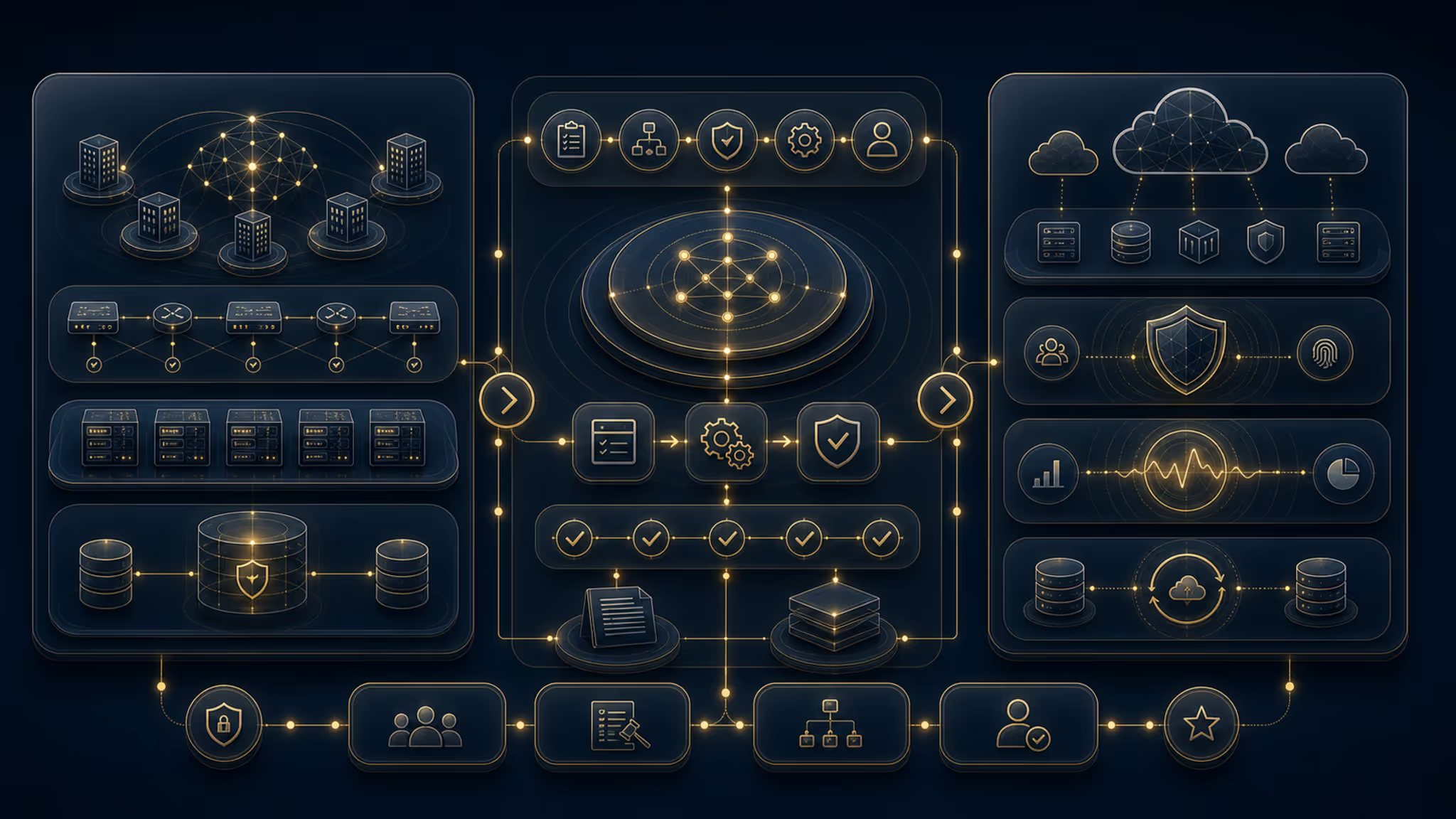
Modernise SD-WAN, Wi-Fi 6/6E and data center networking through a phased architecture path that protects availability, rollback and operational visibility.
EVIDENCEISO 27001ISO 27017KVKKScope record
01Current stateTopology, traffic, and dependency visibility.
02Target architectureSegmentation, capacity, and availability design.
03Controlled cutoverChange window, validation, and rollback plan.
04HypercareMonitoring, tuning, and operational handover.
POSITION
Where this service sits in the portfolio
SERVICE SCOPE
What this service addresses
The critical topics this service addresses and the outcome we deliver in each.
Visibility into critical application traffic
evidence readiness
With flow, log and telemetry design we make branch and data center traffic visible and address bottlenecks at the root-cause level.
A prioritized, measurable roadmap
measured target
A prioritization matrix scoring business impact, security risk and operational bottlenecks yields an improvement plan tied to measurable targets.
Lower change and outage risk
contract-scoped
We proceed with change windows, a rollback plan and validation checklists, applying parallel running and controlled cutover for critical services.
Operations accelerated by standard documentation
contract-scoped
HLD/LLD designs, runbooks and monitoring dashboards reduce operational dependence on external support.
Delivery model
Delivery approach
How we phase the service across delivery, governance, and connected service pillars.
01
We start with a current-state analysis: mapping topology, traffic and dependencies, then clarifying the critical application flow map, bottlenecks and the risk and compliance requirements.
02
We design the target architecture for branch WAN/LAN/WLAN and the data center backbone, shaping SD-WAN, campus LAN/WLAN, segmentation (NAC/VLAN/VRF) and network visibility around measurable goals.
03
We run the migration in phases, cut over with acceptance and failover validation, and complete performance monitoring and knowledge transfer through 30 days of hypercare support.
Operating contexts
Example operating contexts
Illustrative surfaces where this service is commonly activated.
Multi-site branch network standardization
Moving fragmented branch networks to a single standard with an MPLS/Internet/5G connectivity strategy and SD-WAN design.
Campus Wi-Fi 6/6E modernization
Renewing wireless access with a coverage and capacity plan based on a site survey or existing measurements.
Data center network backbone design
Designing the data center backbone and segmentation policies with a high-availability target.
DEPTH
Technical and compliance depth
This service's depth on sector-specific technical and compliance topics.
Segmentation and Zero Trust alignment
Network segmentation and the policy set are designed to align with your existing security architecture; policy points and log flow are handled together.
Monitoring platform integration
Integration with common platforms such as Zabbix, PRTG and Prometheus; flow/log/telemetry-based visibility and alarm definitions.
Controlled migration and acceptance criteria
Acceptance criteria defined through performance testing, capacity validation and failover testing; phased cutover supported by rollback procedures.
What It Solves
Legacy network architectures struggle to meet the demands of hybrid workforces, multi-site operations, and cloud-first application delivery. Organisations face escalating bandwidth costs, inconsistent user experience across branch locations, and insufficient visibility into network performance. Our Strategic Network and Data Center Transformation practice eliminates these bottlenecks by modernising connectivity, compute fabric, and data center topology end-to-end.
SD-WAN design and deployment with application-aware routing
Wi-Fi 6/6E enterprise wireless rollout with RF site surveys
Hyper-Converged Infrastructure (HCI) implementation and migration
Data center fabric redesign with spine-leaf architecture
Key Benefits
Benefit
Make cost and resource optimization measurable against the agreed baseline and review cadence
Benefit
Design contracted availability targets with active-active data center configurations
Benefit
Shorten operational cycle time against agreed measurement targets and acceptance criteria
Nutanix AOS, VMware vSAN, Microsoft Azure Stack HCI
Network Fabric
Cisco ACI, Arista EOS, Juniper Apstra (IBN)
Scope
Our engagement covers the full lifecycle from network discovery and architecture design through to deployment, integration, and ongoing managed operations. We address campus LAN, WAN edge, data center interconnect, and wireless domains, ensuring each layer is aligned with security and compliance requirements. Scope can be adjusted for greenfield builds, partial modernisation, or full data center consolidation programmes.
Current-state network discovery, traffic analysis, and topology documentation
Target architecture design including redundancy, segmentation, and QoS policy
Vendor-neutral procurement advisory and BoM optimisation
Post-deployment NOC monitoring integration and runbook creation
Key Benefits
Benefit
Make risk and response indicators visible through measured controls, rehearsed playbooks, and evidence review
Benefit
Make cost and resource optimization measurable against the agreed baseline and review cadence
Benefit
Make operational speed, resilience, and response outcomes measurable through contracted scope and acceptance criteria
Discovery Tools
SolarWinds NTA, Auvik, Cisco Network Insights
Automation
Ansible Network, Python Netmiko, Terraform
Monitoring
Grafana, Prometheus, SNMP v3, NetFlow/IPFIX
Compliance Frameworks
ISO 27001, NIST SP 800-53, PCI DSS 4.0
Deliverables
Every engagement produces a structured set of artefacts that serve as long-term operational references. From initial design documentation through to post-implementation verification reports, our deliverables are version-controlled and handed over with formal knowledge transfer sessions. All documents conform to ITIL v4 service documentation standards.
As-built network diagrams in Visio and draw.io formats
SD-WAN policy playbooks and QoS configuration templates
Wireless heatmaps and channel plan documentation
HCI cluster sizing reports and DR runbooks
Key Benefits
Benefit
Shorten operational cycle time against agreed measurement targets and acceptance criteria
Benefit
Support audit and compliance readiness with evidence records instead of unsupported public outcome promises
Benefit
Shorten operational cycle time against agreed measurement targets and acceptance criteria
Documentation Standard
ITIL v4, IEEE 802.1 topology diagrams
Version Control
Git-backed configuration repository (GitOps)
Testing Artefacts
UAT sign-off reports, failover test logs
Knowledge Transfer
Instructor-led workshops, recorded sessions, LMS access
Frequently Asked Questions
How long does a typical SD-WAN migration take for a 50-site enterprise?
A phased SD-WAN migration for a 50-site enterprise is planned through a scoped timeline agreed during discovery. We use a pilot-site approach, validating QoS policies and failover behaviour in a controlled environment before rolling out to production sites in batches of 10 to 15 locations.
Can you integrate SD-WAN with our existing MPLS circuits during transition?
Yes. Our hybrid WAN design supports concurrent MPLS and SD-WAN operation, allowing a zero-disruption cutover. MPLS circuits are retained as a premium path for latency-sensitive traffic until the transition is fully validated and the business is ready to decommission them.
Do you provide network operations after the implementation is complete?
Yes. We offer tiered managed network services including contract-scoped NOC monitoring, incident response SLAs, quarterly health reviews, and capacity planning. Managed services are scoped separately and can be transitioned to in-house teams with full knowledge transfer.
How do you handle multi-vendor environments during a transformation?
We apply a vendor-neutral assessment methodology to catalogue all existing assets. Our architects design integration points that preserve existing investments where viable, define a deprecation roadmap for end-of-life equipment, and manage multi-vendor coexistence throughout the transition period.
Are the configuration templates reusable for future site expansions?
Yes. All configuration templates are designed as parameterised blueprints that can be adapted for new sites with minimal customisation. They are stored in a version-controlled repository and come with variable substitution guides so your internal team can deploy new sites independently.
What warranty or support period is included after project handover?
All deployments include a 90-day post-handover hyper-care period with priority access to the project engineers. During this window we respond to configuration-related issues within the agreed response window and provide up to 3 change requests at no additional cost.
Related service groups
Compare the other workstreams under the same pillar as well.