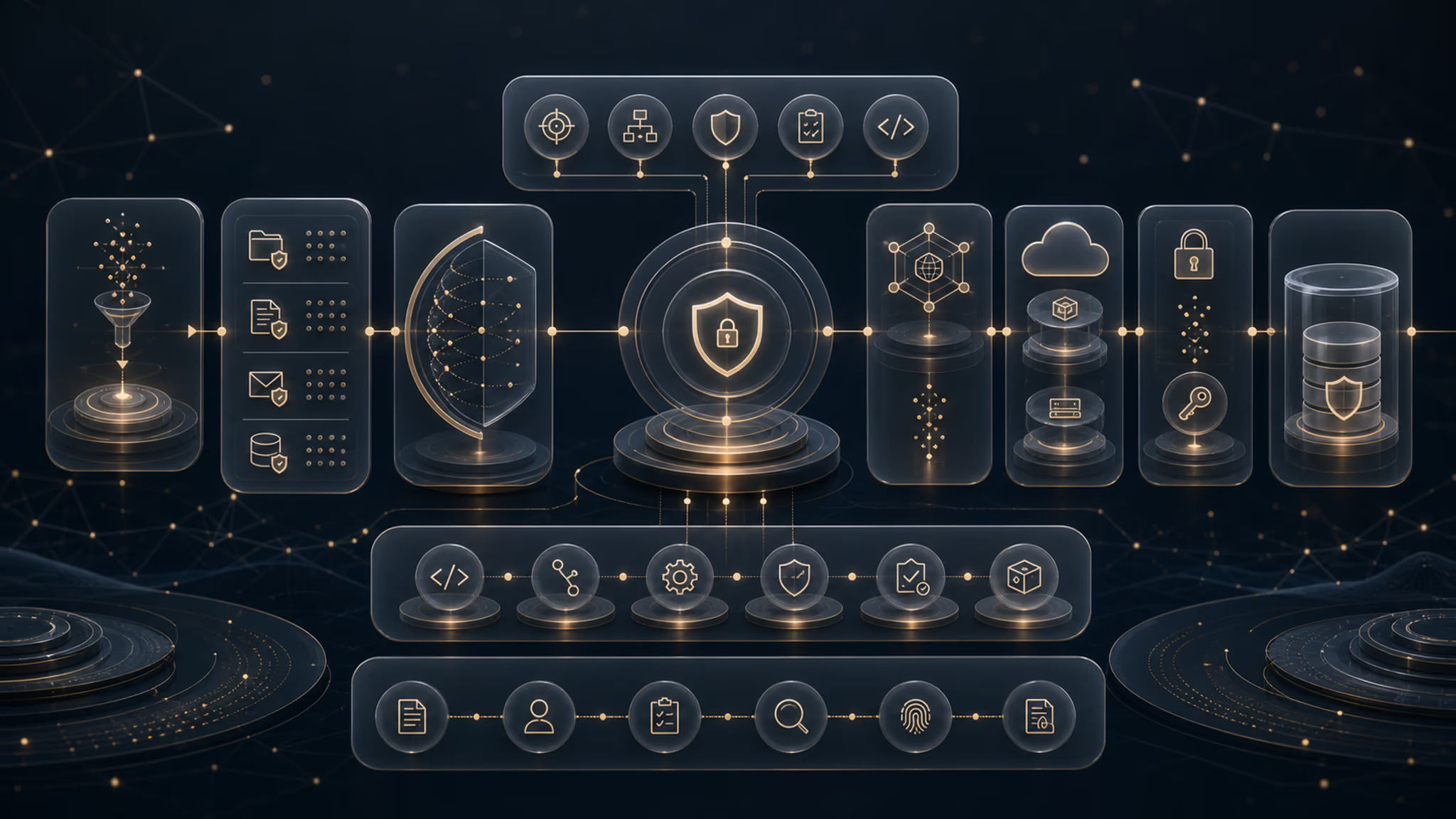
We prevent sensitive-data leaks with DLP, embed security into the development lifecycle (SSDLC), and protect cloud environments against misconfiguration.
EVIDENCEISO 27001KVKKNIS2DORA
01Current stateTopology, traffic, and dependency visibility.
02Target architectureSegmentation, capacity, and availability design.
03Controlled cutoverChange window, validation, and rollback plan.
04HypercareMonitoring, tuning, and operational handover.
POSITION
Where this service sits in the portfolio
SERVICE SCOPE
What this service addresses
The critical topics this service addresses and the outcome we deliver in each.
Reduced data-leak risk
contract-scoped
We roll out data classification and DLP policies in stages (monitor → warn → block) and control the movement of sensitive data across endpoint, network and cloud.
Gaps caught early in development
measured target
We add SAST, DAST, SCA and secret scanning as quality gates in CI/CD and tighten the build-break threshold gradually with the team.
Detection of cloud misconfiguration
evidence readiness
With CSPM we continuously audit cloud security posture against CIS Benchmarks and make misconfigurations visible with a remediation action plan.
Sustainable secure-coding culture
published after approval
Through secure-coding standards and developer training with hands-on labs we support the team in producing secure code independently.
Delivery model
Delivery approach
How we phase the service across delivery, governance, and connected service pillars.
01
Data and DLP: we classify data, roll out DLP policies in monitor mode first and drive adoption with user training.
02
SSDLC integration: we add SAST, SCA and secret scanning as quality-gate steps into your existing CI/CD pipeline and plan the toolchain during discovery.
03
Cloud posture: we run cloud security baseline audits with CSPM and order findings by remediation priority.
Operating contexts
Example operating contexts
Illustrative surfaces where this service is commonly activated.
Sensitive data-leak concern
Organisations wanting to protect customer, financial or special-category data with DLP and control its movement.
Embedding security into development
Software teams wanting to catch security gaps early in development, before they reach production.
Cloud misconfiguration risk
Platform and security teams wanting to continuously audit configuration errors across multi-cloud environments.
DEPTH
Technical and compliance depth
This service's depth on sector-specific technical and compliance topics.
DLP and data classification
With platforms such as Microsoft Purview we build endpoint, network and cloud DLP policies on top of data classification.
SSDLC toolchain
We integrate tools such as SonarQube, Snyk, Trivy, Semgrep and GitLeaks into the pipeline, referencing OWASP Secure Coding and CWE Top 25.
CSPM and cloud baseline
With Azure Defender, AWS Security Hub or Prisma Cloud we provide continuous cloud security auditing based on CIS Benchmarks.
What It Solves
Data breaches increasingly originate from insecure application code and inadequate data loss prevention controls. Organisations developing software without security integrated into the development lifecycle produce vulnerabilities at speed, while unclassified and ungoverned data assets create exposure that DLP cannot address effectively. Our Data and Application Security practice integrates security into every phase of software delivery through SSDLC implementation and deploys data-centric security controls that protect sensitive information regardless of where it resides or travels.
Secure Software Development Lifecycle (SSDLC) programme implementation
Application security testing integration into CI/CD pipelines (SAST, DAST, SCA)
Data Loss Prevention (DLP) architecture design and deployment
Cloud Security Posture Management (CSPM) and cloud workload protection
Key Benefits
Benefit
Make risk and response indicators visible through measured controls, rehearsed playbooks, and evidence review
Benefit
Shorten operational cycle time against agreed measurement targets and acceptance criteria
Benefit
Make risk and response indicators visible through measured controls, rehearsed playbooks, and evidence review
Microsoft Purview, Forcepoint DLP, Symantec DLP, Nightfall AI
Scope
The data and application security engagement covers current-state assessment, architecture design, tooling deployment, process integration, and developer training. We address the full application portfolio from web and mobile applications to APIs and backend services. The DLP scope includes endpoint, network, email, and cloud data channels. Cloud workload protection covers containers, serverless, and virtual machines across all major cloud platforms.
Threat modelling workshops for critical applications using STRIDE or PASTA methodology
Developer security training programme with language-specific secure coding guides
Data classification taxonomy design and automated tagging implementation
API security programme including OAuth 2.0/OIDC implementation review
Key Benefits
Benefit
Shorten operational cycle time against agreed measurement targets and acceptance criteria
Benefit
Improve quality indicators through baselines, acceptance criteria, and reviewed evidence
Benefit
Make risk and response indicators visible through measured controls, rehearsed playbooks, and evidence review
Secure Code Warrior, Checkmarx Codebashing, SANS Developer Training
Data Tagging
Microsoft Purview sensitivity labels, AWS Macie, Google Cloud DLP
API Security
OAuth 2.0, OIDC, OWASP API Security Top 10, mTLS enforcement
Deliverables
Deliverables from the data and application security engagement range from strategic programme documents to technical integration artefacts and training materials. The SSDLC programme is delivered as a living framework with ongoing measurement and improvement mechanisms built in from day one.
Application security programme charter with maturity targets and measurement KPIs
SSDLC process integration guide with phase-by-phase security activity definitions
DLP policy library with classification rules and approved exception workflow
Quarterly application security dashboard with vulnerability trend and remediation velocity metrics
Key Benefits
Benefit
Demonstrate application security maturity to enterprise customers requesting SSDLC evidence in RFPs
Benefit
Shorten operational cycle time against agreed measurement targets and acceptance criteria
Benefit
Provide development leadership with data-driven insights to allocate security remediation budget
Maturity Model
OWASP SAMM v2.0, BSIMM benchmarking
Metrics Dashboard
Defect density per KLOC, MTTM (mean time to mitigate), severity distribution
DLP Documentation
Policy matrix, classification taxonomy, exception process SLA
How do you integrate SAST and DAST into an existing CI/CD pipeline without slowing deployments?
We implement a tiered security testing strategy: fast SAST incremental scans run on every pull request commit (typically within the agreed response window), full SAST scans run nightly, and DAST scans run on staging environment deployments. Only critical and high severity findings block the pipeline; medium and low findings are tracked as technical debt tickets. This approach catches critical issues without impacting developer velocity.
What is the SSDLC and how long does it take to implement?
The Secure Software Development Lifecycle embeds security activities into each phase of your existing development process: security requirements during planning, threat modelling during design, SAST and SCA during coding, DAST during testing, and penetration testing before release. A foundational SSDLC programme covering tooling, training, and process integration is planned through a scoped timeline agreed during discovery to implement and becomes self-sustaining within the agreed response window.
How does DLP handle false positives that block legitimate business operations?
DLP tuning is a structured process. We deploy in audit mode first for 30 days, analyse the false positive rate per policy, and tune classification rules and user scope before switching to enforcement mode. We implement a streamlined exception workflow where users can request a business justification override that is reviewed within the agreed response window during business hours, ensuring DLP does not create unacceptable friction for legitimate workflows.
Can your SSDLC programme work with organisations using multiple development languages and frameworks?
Yes. We support polyglot development environments and select SAST tools with coverage for your specific language mix. Threat modelling and secure coding training are tailored to the frameworks your teams use. We have experience implementing SSDLC across Java, .NET, Python, Go, JavaScript/TypeScript, and mobile (iOS/Android) simultaneously within a single programme.
How is the SSDLC programme measured and improved over time?
We establish a quarterly OWASP SAMM assessment cadence to measure programme maturity against the benchmark. Metrics tracked include defect escape rate (vulnerabilities found post-release versus pre-release), remediation velocity by severity, SAST false positive rate, and developer training completion rate. Results are reviewed in quarterly programme reviews with actionable improvement targets for the next quarter.
What is delivered for cloud security posture management beyond initial deployment?
CSPM deliverables include an initial cloud security posture report with all findings prioritised by severity, a remediation playbook for the top 20 findings, and automated remediation scripts for common misconfigurations such as public buckets and overly permissive security groups. Ongoing CSPM produces a weekly posture report and monthly trend analysis showing posture improvement over time.
Related service groups
Compare the other workstreams under the same pillar as well.