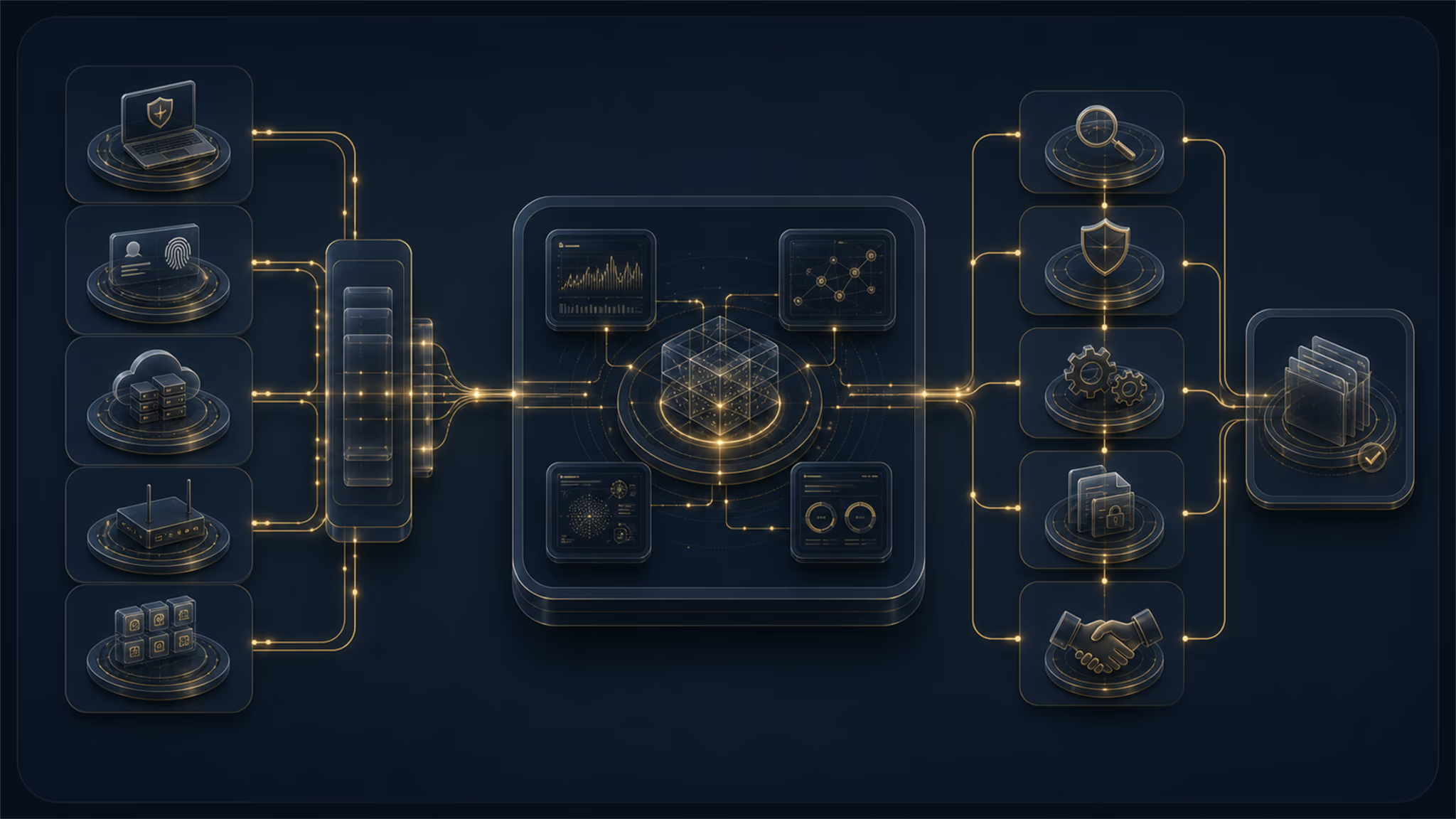
We unify endpoint, network, and cloud telemetry in a single pane; contracted monitoring and threat hunting catch attack signals early, and measuring the MTTD/MTTR baseline lets us automate response flows.
EVIDENCEISO 27001KVKKNIS2DORA
01Current stateTopology, traffic, and dependency visibility.
02Target architectureSegmentation, capacity, and availability design.
03Controlled cutoverChange window, validation, and rollback plan.
04HypercareMonitoring, tuning, and operational handover.
POSITION
Where this service sits in the portfolio
SERVICE SCOPE
What this service addresses
The critical topics this service addresses and the outcome we deliver in each.
Unified single-pane visibility
contract-scoped
We merge endpoint, network and cloud telemetry through SIEM correlation, relating firewall, proxy, AD, O365 and cloud-trail logs with correlation rules.
Measured detection and response time
measured target
We establish the MTTD/MTTR baseline during onboarding and track progress against measurement targets bound to scope and acceptance criteria.
Reduced dwell time through automation
evidence readiness
With SOAR playbooks we automate IOC enrichment, IP/domain blocking and ticket creation, reducing repetitive manual steps.
Regular threat intelligence
contract-scoped
Monthly threat intelligence reports and IOC updates keep the defence current; weekly SOC summaries keep operations visible.
Delivery model
Delivery approach
How we phase the service across delivery, governance, and connected service pillars.
01
Telemetry integration: we connect log sources (firewall, proxy, AD, O365, cloud trail, endpoint) to the SIEM and build correlation rules around your use cases.
02
Detection and hunting: we roll out EDR/XDR agents after measuring performance impact in a pilot group, and run threat hunting with IOC/TTP analysis.
03
Automation and reporting: we automate response flows with SOAR playbooks and track SLAs through weekly SOC summaries and monthly threat reports.
Operating contexts
Example operating contexts
Illustrative surfaces where this service is commonly activated.
After-hours coverage need
Organisations wanting to strengthen an existing SOC team with after-hours coverage, expertise and automated playbooks.
Scattered security telemetry
Teams unable to unify endpoint, network and cloud logs into one pane and correlate them.
Prolonged response times
Security operations aiming to shorten incident response time (MTTR) against measurable targets.
DEPTH
Technical and compliance depth
This service's depth on sector-specific technical and compliance topics.
SIEM and correlation
We build log-source integration and correlation rules on Microsoft Sentinel, Splunk or Elastic Security, prioritising your existing investment.
EDR/XDR and hunting
We provide endpoint protection and IOC/TTP-based threat hunting with CrowdStrike, SentinelOne or Microsoft Defender XDR.
SOAR automation
With automated playbooks, enrichment and ticket integration we standardise response flows and clarify the escalation matrix.
What It Solves
Organisations often lack contract-scoped security operations capability, skilled analyst capacity, and integrated tooling required to detect and respond to modern threats. Alert fatigue from disconnected SIEM and endpoint security tools overwhelms in-house teams and can cause critical threats to go undetected. Our Managed Detection and Response service deploys an integrated XDR platform backed by a Security Operations Centre model, transforming reactive alert management into proactive threat hunting and automated response.
Contract-scoped SOC monitoring with defined analyst coverage
SIEM deployment and management (Sentinel, Splunk, IBM QRadar)
Extended Detection and Response (XDR) platform integration across endpoint, network, and cloud
Threat hunting programmes with MITRE ATT&CK coverage mapping
Key Benefits
Benefit
Shorten operational cycle time against agreed measurement targets and acceptance criteria
Benefit
Make risk and response indicators visible through measured controls, rehearsed playbooks, and evidence review
Benefit
Make cost and resource optimization measurable against the agreed baseline and review cadence
SIEM Platforms
Microsoft Sentinel, Splunk Enterprise Security, IBM QRadar, Elastic SIEM
XDR Platforms
Microsoft Defender XDR, CrowdStrike Falcon XDR, Palo Alto Cortex XDR
Threat Intel
MITRE ATT&CK, ISAC feeds, commercial TI (Recorded Future, ThreatConnect)
SOAR
Microsoft Sentinel Playbooks, Splunk SOAR, Palo Alto XSOAR
Scope
The MDR/XDR engagement covers sensor deployment and SIEM onboarding, platform tuning and use case development, contract-scoped monitoring, incident response, and monthly service reporting. We integrate with your existing security tools, ITSM platforms, and escalation contacts to support operational handover. The scope includes initial threat hunt campaigns and a baseline MITRE ATT&CK coverage assessment.
Log source onboarding with normalisation and data quality validation
Detection rule engineering and custom use case development for your environment
Incident response retainer with defined escalation and SLA commitments
Monthly threat intelligence briefing tailored to your sector and geography
Key Benefits
Benefit
Turn the outcome into a measurable target with baseline, owner, and review cadence
Benefit
Improve quality indicators through baselines, acceptance criteria, and reviewed evidence
Benefit
Make risk and response indicators visible through measured controls, rehearsed playbooks, and evidence review
Rapid Response (15-min), Standard (1-hr), Advisory (4-hr)
Compliance Mapping
NIST CSF Detect/Respond, ISO 27035 incident management, GDPR Art. 33
Deliverables
MDR/XDR service deliverables combine real-time operational artefacts with periodic strategic reports. Daily security operations are documented in the case management system with full audit trail. Monthly and quarterly reports provide trend analysis, coverage improvement evidence, and threat intelligence summaries for the CISO and board.
Service onboarding report with log source inventory and coverage baseline
Monthly security operations report with MTTD/MTTR metrics and incident trends
MITRE ATT&CK coverage heatmap updated quarterly
Post-incident reports (PIRs) for all critical and high severity incidents
Key Benefits
Benefit
Demonstrate security operations maturity to cyber insurance underwriters with documented SLA performance
Benefit
Support regulatory breach notification obligations with precise incident timeline documentation
Benefit
Identify detection coverage gaps and plan improvements with quarterly ATT&CK heatmap reviews
Case Management
ServiceNow SecOps, Jira Service Management, TheHive
What is the difference between MDR and a traditional MSSP?
Traditional MSSPs typically provide alert monitoring and escalation, passing incidents to the client for investigation. MDR goes further with active investigation, threat hunting, and approved response actions such as endpoint isolation, account disablement, and firewall rule changes. Response improvement is measured against the agreed baseline and scope.
How are SOAR playbooks developed and validated before going into production?
Playbooks are developed through a structured process: threat scenario identification, analyst workflow documentation, automated action mapping, and testing in a non-production environment against simulated attack data. All playbooks require dual approval from a senior analyst and the client's security team lead before production deployment. They are reviewed quarterly and updated after significant incidents or threat landscape changes.
How do you handle a major incident requiring on-site response?
Our retainer agreements include provisions for on-site incident response deployment. Upon critical incident declaration, a digital forensics and incident response team can be mobilised to your primary site within the agreed response window (major metro areas) or 24 hours (regional sites). Remote forensics capabilities are engaged immediately in parallel while travel is arranged.
Can MDR/XDR services cover multi-cloud and OT environments in addition to traditional IT?
Yes. Our XDR platform integrations extend to cloud-native security tools (Defender for Cloud, GuardDuty) and OT/ICS monitoring via vendors such as Claroty and Dragos. We build separate detection use cases for OT environments that account for the sensitivity of industrial protocols and the unacceptable impact of automated response actions on operational technology.
How quickly are post-incident reports delivered after a significant security event?
A preliminary post-incident report covering timeline, initial indicators of compromise, and immediate containment actions is delivered within the agreed response window of incident closure. The full post-incident report including root cause analysis, attack chain reconstruction, lessons learned, and recommended improvements is delivered within 5 business days.
Are MDR service metrics available in real time via API for integration with our GRC platform?
Yes. Our service portal exposes a REST API for key metrics including open incident count by severity, MTTD/MTTR rolling averages, and coverage percentage by ATT&CK technique. These can be pulled by GRC platforms such as ServiceNow IRM or custom dashboards to maintain a real-time security operations view within your existing governance tooling.
Related service groups
Compare the other workstreams under the same pillar as well.