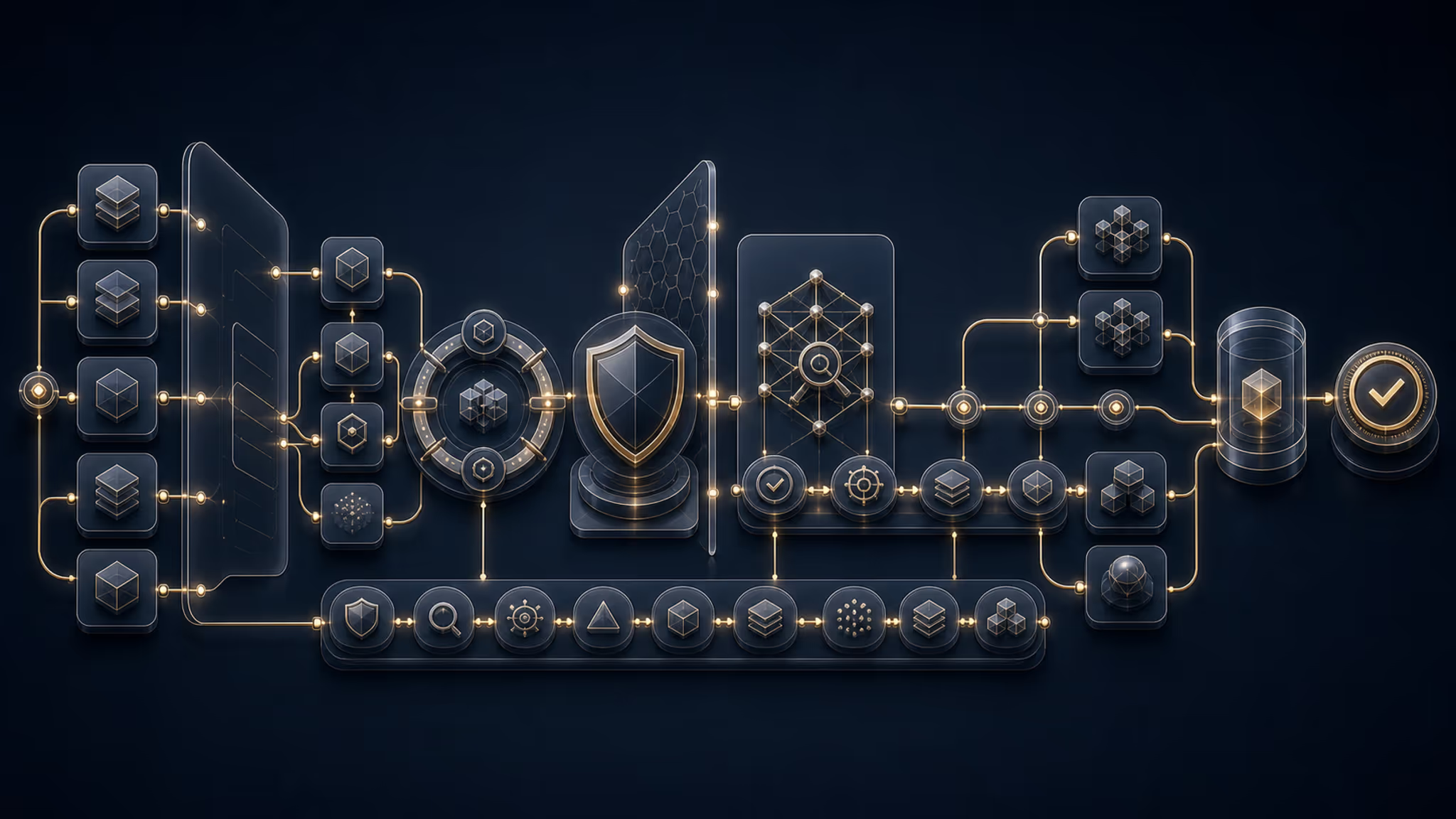
We build secure SDLC, quality gates, and test strategy in one frame; risk surfaces early and acceptance criteria stop being debatable.
EVIDENCEISO 27001OWASP ASVSScope recordRisk note
01Current stateTopology, traffic, and dependency visibility.
02Target architectureSegmentation, capacity, and availability design.
03Controlled cutoverChange window, validation, and rollback plan.
04HypercareMonitoring, tuning, and operational handover.
POSITION
Where this service sits in the portfolio
SERVICE SCOPE
What this service addresses
The critical topics this service addresses and the outcome we deliver in each.
Security-quality decision in one framework
contract-scoped
Making the decision context and technical scope visible in one language across secure SDLC, quality gates and test strategy is carried out through a problem map, scope note and evidence boundary as outputs.
Risk made visible early
evidence readiness
Separating assumptions, risk and pipeline dependencies at an early stage; the aim is to make risk visible early and acceptance criteria undisputed through current-state, target-state and gap reading.
Claims aligned with the evidence boundary
published after approval
Keeping public claims aligned with the evidence boundary; the separation of publishable evidence from owner-gated evidence is protected with evidence-based content and schema language.
An actionable roadmap
measured target
Forming an actionable roadmap and a risk priority matrix after the first assessment, with the aim of teams sharing a common view of scope, responsibility and acceptance criteria.
Delivery model
Delivery approach
How we phase the service across delivery, governance, and connected service pillars.
01
Work starts with clarifying the decision objective, current state, data sources and publishable-evidence boundaries with CISO, CTO, QA leader and application teams; live Google data, customer evidence or certification claims are not opened at this stage.
02
Scope is defined as the current-state reading of secure SDLC and quality gates, the target operating model, pipeline dependencies, responsibility separation and a evidence-based content boundary; live accounts, prod environment and customer data are not part of the package.
03
Delivery proceeds as a short security-quality discovery, a control decision framework, risk prioritization and a evidence-based output package; outputs use measurement and evidence language and do not promise definite performance or revenue outcomes.
Operating contexts
Example operating contexts
Illustrative surfaces where this service is commonly activated.
Pulling risk earlier
Addressing security, quality and delivery rhythm in a single framework so that risk becomes visible early rather than late.
Clarifying acceptance criteria
Making quality gates and acceptance criteria undisputed and separating responsibility and escalation points.
Choosing the control slice
Assessing business impact, technical dependency and compliance risk and opening the secure-SDLC control slice with separate scope.
DEPTH
Technical and compliance depth
This service's depth on sector-specific technical and compliance topics.
Focus and decision roles
The focus is secure SDLC, quality gates and test strategy; decision roles are CISO, CTO, QA leader and application teams. The output consists of a problem map, scope note and evidence boundary.
Scope and evidence boundary
Scope covers content depth and implementation readiness; the evidence boundary is the separation of repo-local content, visible scope and owner-gated evidence. Launch, live accounts, customer evidence and certification publishing are excluded.
Delivery approach
The approach proceeds as discovery, decision framework, prioritization and evidence-based output. The delivery format is a brief, roadmap, acceptance criteria and evidence boundary; acceptance is defined with measurable criteria tied to contract and owner approval.
What It Solves
Application Security & Quality Engineering makes the decision goal, current state, dependencies, and evidence boundary visible across secure SDLC, quality gates, and test strategy. Risk appears late and acceptance criteria stay contested when security, quality, and delivery cadence are tracked separately; DH separates the problem, the decision owner, and the next implementation step.
Decision-goal and scope clarity for CISO, CTO, QA lead, and application teams
Current-state and dependency reading across secure SDLC, quality gates, and test strategy
Separation of publishable evidence and owner-gated proof
Key Benefits
Benefit
Business, technology, and compliance context stays aligned
Benefit
Assumptions, risks, and dependencies are separated early
Benefit
Public claims stay aligned with the available proof boundary
Focus
secure SDLC, quality gates, and test strategy
Decision Roles
CISO, CTO, QA lead, and application teams
Output
Problem map, scope note, and evidence boundary
Scope
Scope covers the current-state review of the secure SDLC and quality gates, the target operating model, pipeline dependencies, responsibility boundaries, and the publishable-content boundary. Live accounts, production environments, customer data, and external publishing activation are outside this package for secure SDLC, quality gates, and test strategy.
Current-state, target-state, and gap reading
Responsibility, approval, and escalation separation
Evidence-based content, schema, and quick-answer language
Key Benefits
Benefit
Business, technology, and compliance expectations land in one scope note
Benefit
Ownership and decision points are clear before implementation
Benefit
DH keeps its position as a 360-degree enterprise technology partner
Scope Type
Content depth and implementation readiness
Evidence Boundary
Repo-local content, visible scope, and owner-gated proof separation
Excluded
Launch, live account, customer proof, and certification publication
Delivery Approach
Delivery proceeds as short security-and-quality discovery, control decision framing, risk prioritization, and a evidence-based output package. Outputs for secure SDLC, quality gates, and test strategy use measurement and evidence language; they do not promise fixed performance, compliance, or revenue outcomes.
Short discovery and decision framing
Priority matrix and implementation-slice recommendation
Evidence-based executive summary and content brief
Key Benefits
Benefit
A practical roadmap is visible after the first review
Benefit
Teams see scope, responsibility, and acceptance criteria together
Benefit
Later UI and launch steps have a cleaner evidence base
Brief, roadmap, acceptance criteria, and evidence boundary
Acceptance
Measurable acceptance criteria tied to contract and owner approval
Frequently Asked Questions
Where does Application Security & Quality Engineering start?
The first step aligns CISO, CTO, QA lead, and application teams around the decision goal, current state, data sources, risks, and publishable evidence boundaries. Live Google data, customer proof, and certification claims are not activated in this phase.
How do the outputs connect to implementation?
Discovery outputs become scope, roadmap, responsibility matrix, and acceptance criteria. Implementation, budget, SLA, and live-environment decisions proceed under a separate contract and owner approval.
Does this scope include live-system changes?
No. This is a content and readiness scope. Live systems, publishing, providers, secrets, and customer data require separate owner approval.
Which decision owners should be involved?
CISO, CTO, QA lead, and application teams, plus operations, compliance, and technical owners, should be reviewed together so the decision, scope, and evidence expectations use one language.
Are the outputs a fixed success commitment?
No. The outputs support decision and implementation readiness. Success, SLA, compliance, and commercial outcome claims require approved proof and contract scope.
How is the next step selected?
Business impact, technical dependency, compliance risk, and team readiness are reviewed together. The next implementation slice opens under its own scope and proof gate.
Related service groups
Compare the other workstreams under the same pillar as well.