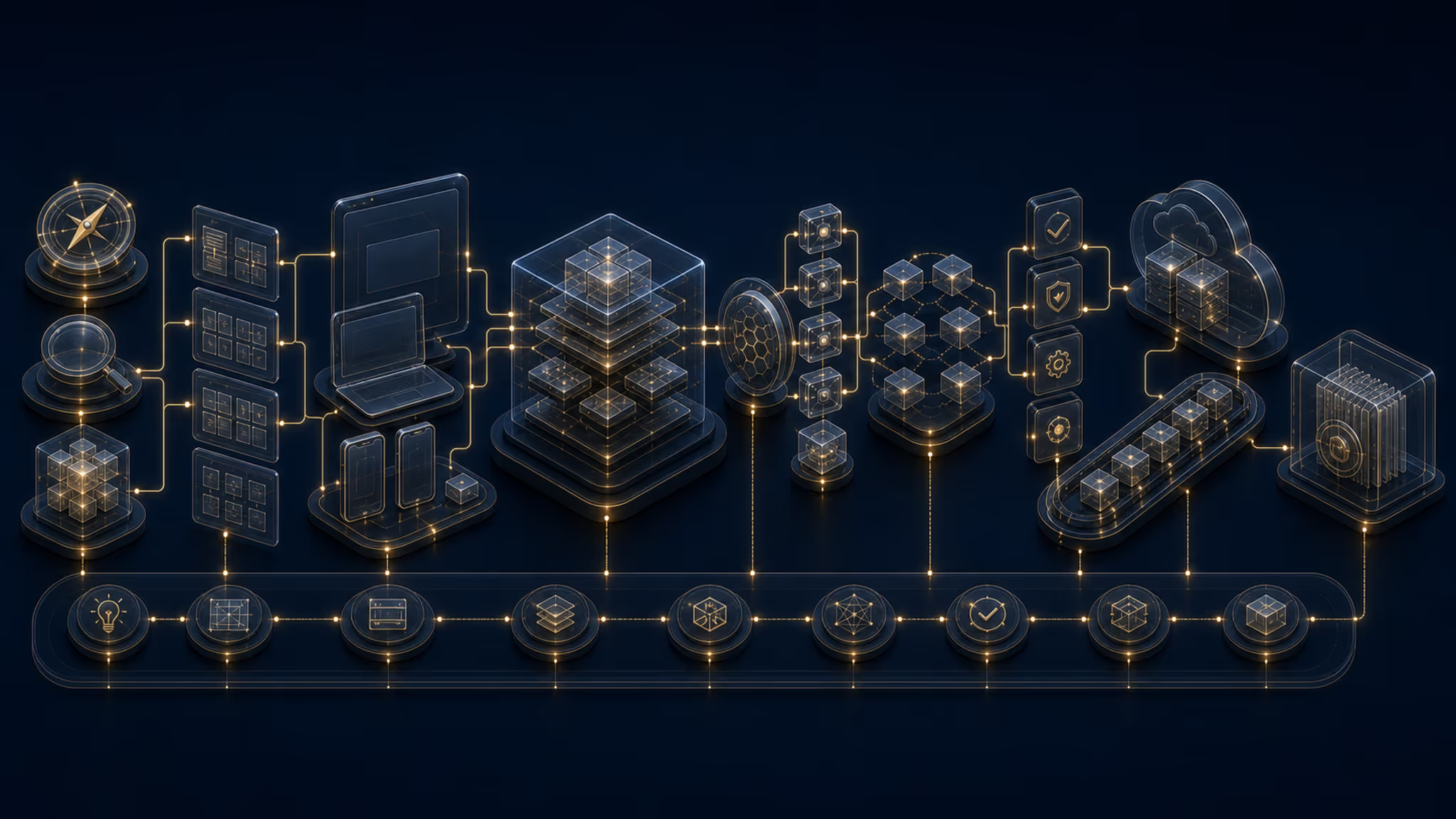
We develop web, mobile, and desktop applications tailored to business requirements; digitizing the processes packaged software cannot cover restores efficiency.
EVIDENCEISO 27001OWASP ASVSScope recordRisk note
01Current stateTopology, traffic, and dependency visibility.
02Target architectureSegmentation, capacity, and availability design.
03Controlled cutoverChange window, validation, and rollback plan.
04HypercareMonitoring, tuning, and operational handover.
POSITION
Where this service sits in the portfolio
SERVICE SCOPE
What this service addresses
The critical topics this service addresses and the outcome we deliver in each.
Digitization tailored to your processes
contract-scoped
We digitize processes that off-the-shelf packages cannot cover through web, mobile and desktop applications, and make operational time and resilience targets measurable through contracted scope and acceptance criteria.
Multi-platform from one code base
measured target
With .NET MAUI, React Native and Flutter we aim to target web and mobile platforms at once from a single code base, reducing development and maintenance overhead.
Source-code ownership
evidence readiness
All source code, documentation and intellectual property are yours; Git repository access is handed over, supporting a delivery principle that lets you continue with a different team and reduces vendor lock-in.
A sustainable quality base
published after approval
With Clean Architecture and automated test layers (unit, integration, E2E), the approach of making stakeholder trust and adoption impact traceable through demonstrable indicators is defined together with the customer as measurement targets.
Delivery model
Delivery approach
How we phase the service across delivery, governance, and connected service pillars.
01
Work begins with requirements analysis and user-story writing, then continues with UX research and Figma-based UI design to map the processes specific to your organization.
02
Development runs on the Scrum methodology in two-week sprints; working software is delivered at the end of each sprint, and your team in the Product Owner role makes prioritization and acceptance decisions.
03
Integration with existing ERP, CRM and accounting systems is built with an API-first architecture; for systems without a ready API, an adapter layer is developed to enable cross-system flow.
Operating contexts
Example operating contexts
Illustrative surfaces where this service is commonly activated.
An operation the package cannot fit
End-to-end digitization, through a custom application, of an organization-specific operational process that packaged software does not cover.
Web and mobile in one product
Delivering a service for customers or field teams as both web and mobile from a single code base.
From MVP to full product
Establishing proof of value with an 8-12 week MVP, then expanding the accepted scope into a full enterprise application.
DEPTH
Technical and compliance depth
This service's depth on sector-specific technical and compliance topics.
Technology range
.NET 10, Node.js and Python (FastAPI) for backend; Blazor SSR, React and Next.js for frontend; .NET MAUI, React Native and Flutter for mobile; SQL Server, PostgreSQL, MongoDB and Redis at the data layer.
Architectural discipline
Clean Architecture and DDD are the foundation; CQRS and Event Sourcing come in where needed. Quality is handled with xUnit, Playwright and static analysis; delivery runs through GitHub Actions, Azure DevOps and Docker.
Delivery and maintenance
At project close, a working application on staging and production, the Git repository, architecture and OpenAPI documentation and a deployment guide are delivered. Contracted maintenance covers security patches, minor updates and monitoring.
What It Solves
Off-the-shelf software packages rarely fit the specific operational workflows, competitive differentiators, and integration requirements of enterprise organizations — resulting in costly customizations, process workarounds, and productivity losses. Our Enterprise App Development practice designs and builds custom web, mobile, and desktop applications that precisely match your business logic, integrate natively with existing enterprise systems, and scale to meet demand without architectural compromise. We deliver production-grade software using modern technology stacks, clean architecture principles, and comprehensive automated testing.
Custom web application development using React, Angular, Blazor, and Next.js with enterprise UX standards
Native and cross-platform mobile app development for iOS and Android using Swift, Kotlin, and .NET MAUI
Microservices and API-first backend architecture using .NET, Node.js, and Java Spring Boot
Enterprise integration connectors for SAP, Salesforce, Microsoft 365, and custom legacy systems
Key Benefits
Benefit
Make cost and resource optimization measurable against the agreed baseline and review cadence
Benefit
Shorten operational cycle time against agreed measurement targets and acceptance criteria
Benefit
Make cost and resource optimization measurable against the agreed baseline and review cadence
Our enterprise app development engagements span discovery and requirements engineering, UX research and design, architecture and technical specification, agile development, quality assurance, deployment, and post-launch support. We embed a cross-functional squad — product owner, UX designer, tech lead, developers, and QA engineer — within your project for the duration. Knowledge transfer and developer onboarding ensure your internal team can maintain and extend the application independently after handover.
Product discovery sprint with user research, journey mapping, and prioritized feature backlog creation
UX design system creation with accessibility-first design following WCAG 2.2 AA standards
Automated testing suite covering unit, integration, and end-to-end tests with minimum 80% code coverage target
DevSecOps pipeline with SAST, DAST, dependency scanning, and container security integrated into CI/CD
Key Benefits
Benefit
Validate core user journeys and technology assumptions in a 2-week discovery sprint before committing full budget
Benefit
Make operational speed, resilience, and response outcomes measurable through contracted scope and acceptance criteria
Benefit
Shorten operational cycle time against agreed measurement targets and acceptance criteria
Testing
xUnit, Jest, Playwright, k6 load testing, OWASP ZAP DAST
Deliverables include the fully deployed production application, complete source code in a client-owned repository, architecture documentation, operational runbooks, and a 90-day hypercare support period. We provide a technical handover package designed to enable your development team to own and extend the application independently within the agreed response window of handover training completion.
Production-deployed application with infrastructure-as-code (Terraform/Bicep) and CI/CD pipeline
Complete source code with clean architecture documentation, ADRs, and developer onboarding guide
Test suite with documented coverage reports and instructions for maintaining and extending tests
90-day hypercare with 4-hour response SLA for critical production issues
Frequently Asked Questions
How do you ensure the custom application can scale as our organization grows?
Scalability is designed into the architecture from day one: we implement horizontal scaling through stateless service design and Kubernetes orchestration, use asynchronous messaging (Azure Service Bus, RabbitMQ) to decouple workloads, and conduct load testing against 3–5x expected peak traffic before go-live. Auto-scaling policies ensure the application handles demand spikes without manual intervention.
How do you manage scope and prevent project overrun in custom software development?
We use a fixed-scope/time-boxed sprint model with a detailed backlog groomed before development begins. Change requests are evaluated through a formal impact assessment and require product owner approval before inclusion. Weekly stakeholder demos ensure requirements are validated continuously, catching misalignments early when correction cost is low.
What is your approach to UI/UX design for enterprise applications?
We follow a research-driven design process: stakeholder interviews and user observation sessions in week 1–2 identify actual workflow pain points, low-fidelity wireframes are validated in moderated usability sessions before high-fidelity design begins, and we establish a component design system in Figma that maps directly to coded UI components, ensuring design-to-code consistency and accelerating future feature development.
Do you support regulated industries with specific compliance requirements?
Yes. Our enterprise app practice includes compliance-aware development frameworks for regulated sectors: financial services (PCI-DSS, SOX, BRSA), healthcare (HL7 FHIR, HIPAA), and public sector (ISO 27001, eIDAS). We integrate compliance requirements into architecture decisions, testing criteria, and documentation from the discovery phase.
What licensing model applies to the custom software developed?
All custom source code developed specifically for your organization is transferred as your intellectual property upon final payment. Open-source libraries used within the application are documented in a Software Bill of Materials (SBOM) with license classifications. We ensure no copyleft licenses (GPL, AGPL) are embedded in ways that would impose obligations on your proprietary code.
How do you handle application performance monitoring in production?
We instrument applications with Application Performance Monitoring (APM) from day one using Azure Application Insights, Datadog APM, or OpenTelemetry-compatible collectors. Distributed tracing captures end-to-end request flows across microservices, error rate and latency dashboards are configured with alerting thresholds, and synthetic monitoring confirms critical user journeys are functioning every 5 minutes.
Related service groups
Compare the other workstreams under the same pillar as well.