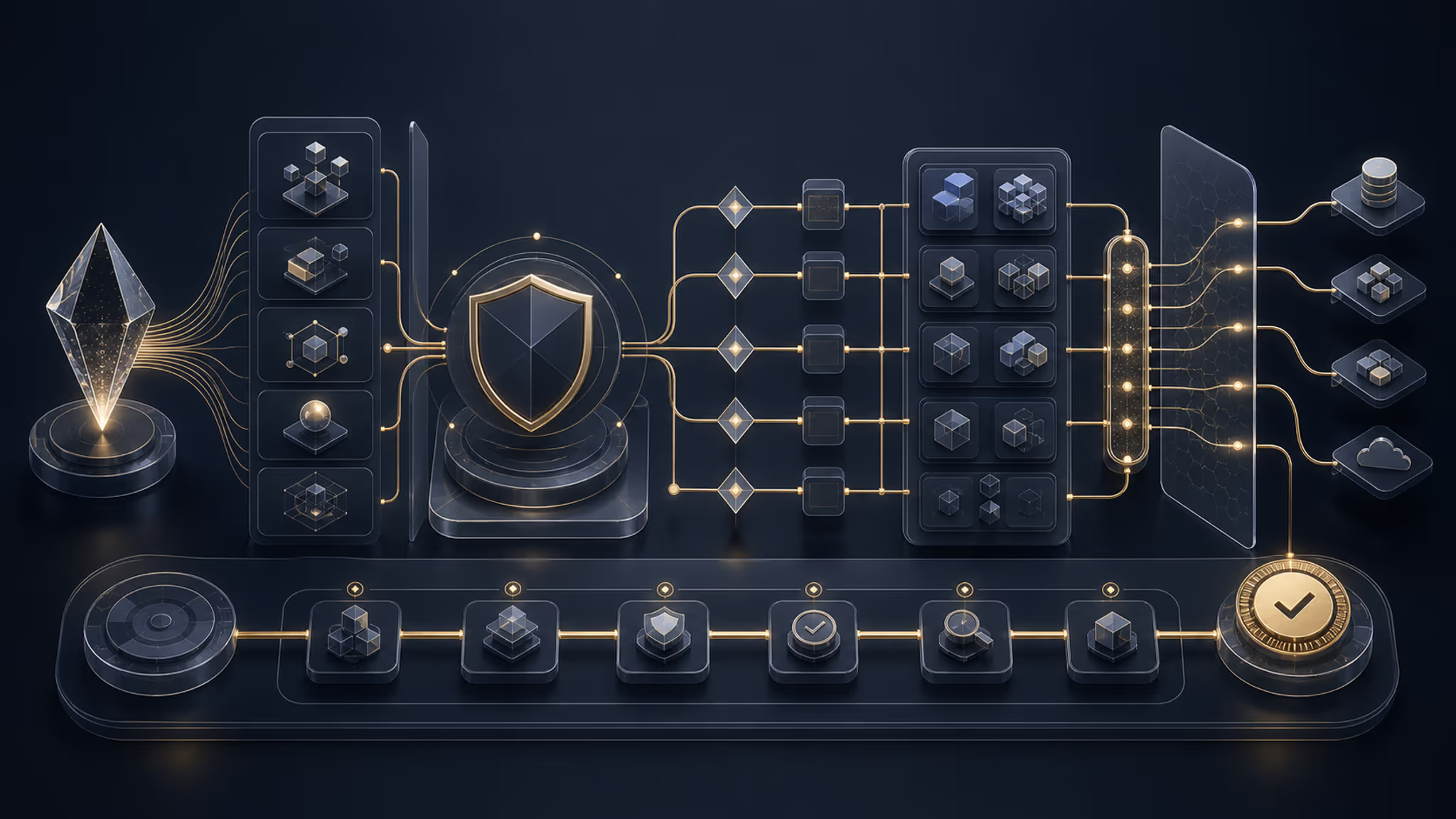
Visual development platforms multiply application delivery speed; we empower business users and resolve the bottleneck that breeds shadow IT.
EVIDENCEISO 27001OWASP ASVSScope recordRisk note
01Current stateTopology, traffic, and dependency visibility.
02Target architectureSegmentation, capacity, and availability design.
03Controlled cutoverChange window, validation, and rollback plan.
04HypercareMonitoring, tuning, and operational handover.
POSITION
Where this service sits in the portfolio
SERVICE SCOPE
What this service addresses
The critical topics this service addresses and the outcome we deliver in each.
Faster application delivery
contract-scoped
The aim of multiplying delivery speed with visual development platforms is tracked together with making operational time and quality indicators measurable through acceptance criteria.
Empowered citizen developers
measured target
Business-unit users become application developers with Power Apps, Power Automate and Power BI; the aim is to grow capable citizen developers through a certification program.
Controlled shadow IT
evidence readiness
Turning shadow-IT risk into controlled citizen development through DLP policies, connector restrictions, environment isolation and code-review processes is ensured with a governance framework.
Low-risk platform validation
published after approval
Validating platform fit at low risk with a 2-4 week POC, and building proof of value with pilot applications, is carried out with criteria defined together with the customer.
Delivery model
Delivery approach
How we phase the service across delivery, governance, and connected service pillars.
01
Work starts with platform evaluation and a POC; options such as Power Platform, OutSystems and Mendix are compared per business scenario and fit is validated at low risk.
02
The environment is set up isolated as dev/test/prod; a governance framework is defined with environment management, DLP and connector policies to prepare the ground for controlled growth.
03
Citizen-developer training is delivered at beginner and advanced levels and sustained with a monthly dojo; with a Center of Excellence model, application inventory, usage metrics and compliance score are tracked.
Operating contexts
Example operating contexts
Illustrative surfaces where this service is commonly activated.
Opening the business-unit bottleneck
Quickly meeting internal application demand that IT cannot keep up with, through citizen developers under governance.
Pro-developer complex application
Professional developer teams building complex enterprise applications on a visual platform with OutSystems or Mendix.
Proof of value with a pilot
Building proof of value and adoption momentum with 2-3 pilot applications at different complexity levels.
DEPTH
Technical and compliance depth
This service's depth on sector-specific technical and compliance topics.
Platform range
Power Apps, Power Automate and Power BI for citizen developers; OutSystems and Mendix for pro developers and complex applications. Custom API integration is possible with 400+ ready connectors.
Governance and CoE
Governance covers environment management, DLP and connector policies and is run with a Center of Excellence model. Training is delivered as beginner (2 days), advanced (3 days) and a monthly dojo.
Deliverables
A configured dev/test/prod environment, a governance handbook and policies, training materials with a video library, and 2-3 pilot applications at different complexity levels are delivered.
What It Solves
Enterprise backlogs are dominated by tactical applications — internal tools, process automation, forms-based workflows, and departmental dashboards — that require months of developer time when built from scratch but could be delivered in weeks using modern low-code and no-code platforms. Our Low-Code / No-Code Development practice enables organizations to dramatically accelerate application delivery by strategically applying platforms such as Microsoft Power Platform, OutSystems, Mendix, and ServiceNow App Engine to appropriate use cases, while maintaining enterprise governance, security standards, and integration architecture consistency. We govern citizen developer programs that scale without creating shadow IT or ungoverned application sprawl.
Low-code platform selection and enterprise deployment using Power Platform, OutSystems, Mendix, or Appian
Center of Excellence (CoE) establishment for platform governance, citizen developer enablement, and application lifecycle management
Automated enterprise connector library enabling low-code apps to securely access approved data sources and APIs
Application governance framework covering security review, data classification, and production approval workflows for citizen-built apps
Key Benefits
Benefit
Turn the outcome into a measurable target with baseline, owner, and evidence review cadence
Benefit
Turn the outcome into a measurable target with baseline, owner, and review cadence
Benefit
Make cost and resource optimization measurable against the agreed baseline and review cadence
Low-Code Platforms
Microsoft Power Apps/Automate, OutSystems, Mendix, Appian, ServiceNow App Engine
No-Code Tools
Microsoft Power Pages, Airtable, Retool, Bubble for specific use cases
Governance
Power Platform CoE Starter Kit, ALM (Application Lifecycle Management) pipelines
Integration
Power Platform connectors (900+), custom REST connectors, on-premises data gateway
Scope
Our low-code engagements cover platform deployment and configuration, CoE establishment, citizen developer training, and delivery of the first wave of governed applications. We integrate the low-code platform into your existing enterprise architecture — connecting to approved data sources, enforcing security policies through API management, and establishing ALM pipelines for test, staging, and production environment promotion. Ongoing CoE operations support and platform administration can be delivered as a managed service.
Enterprise platform deployment with tenant configuration, security policies, and environment strategy (dev/test/prod)
CoE Starter Kit deployment with application inventory, usage telemetry, compliance monitoring, and maker management
Citizen developer training program: beginner workshop series, advanced certification track, and maker community setup
ALM pipeline configuration enabling governed promotion of citizen-built apps through approval-gated environment stages
Key Benefits
Benefit
Make operational speed, resilience, and response outcomes measurable through contracted scope and acceptance criteria
Benefit
Establish ALM pipelines that enforce security review and testing before any app reaches production
Benefit
Build an internal maker community that sustains platform adoption and knowledge sharing independently
Environment Strategy
Development, Test, UAT, Production environments with DLP policy enforcement
Data Loss Prevention policies classifying connectors as Business, Non-Business, or Blocked
Monitoring
CoE telemetry dashboard, app health monitoring, license consumption reporting
Deliverables
Deliverables include a production-deployed enterprise low-code platform, an operational CoE with governance tooling, 2–5 production applications from the first delivery wave, and a citizen developer training program. The CoE Playbook documents all governance policies, application approval workflows, maker onboarding procedures, and platform operations runbooks — enabling your team to run the program independently.
Production low-code platform deployment with DLP policies, environment strategy, and ALM pipelines configured
Deployed CoE with governance dashboard, maker registry, and compliance monitoring active
2–5 production applications from first wave demonstrating platform patterns and integration templates
How do we decide which applications should be built low-code versus traditional code?
Timeline is confirmed during discovery based on scope, integration complexity, current maturity, and acceptance criteria. The project plan is tied to approved scope and dependencies.
What are the risks of low-code platforms and how do you mitigate them?
Key risks include vendor lock-in (mitigated by selecting platforms with open data export and standard API integration), ungoverned citizen development creating security gaps (mitigated by CoE governance with mandatory security review gates), and performance limitations for complex use cases (mitigated by the use-case classification framework that routes complex requirements to traditional development). We document platform constraints and exit strategies in ADRs for every platform selection decision.
How do you prevent citizen developers from building apps that expose sensitive data?
We implement Data Loss Prevention (DLP) policies at the tenant level that classify all connectors — preventing citizen developers from combining business data connectors with consumer-grade or unapproved external services. Applications accessing Tier-1 sensitive data require an IT security review before production approval. The CoE compliance dashboard continuously scans for policy violations and reports out-of-compliance applications to platform administrators.
What happens when a citizen-built application becomes too complex for the low-code platform?
We establish an application complexity assessment process triggered by defined metrics: performance degradation, complex custom code injection, or functional requirements exceeding platform capabilities. When an application crosses the complexity threshold, our traditional development team conducts a migration assessment, produces a re-platforming estimate, and manages the transition with data migration from the low-code platform data stores to a proper persistence layer.
How do you measure ROI of the low-code program for executive reporting?
We configure a FinOps and productivity dashboard from day one tracking: applications delivered (vs. traditional development estimate), development hours saved, backlog items resolved, license cost per application versus traditional development cost, and active maker count growth. Monthly executive reports summarize total ROI with a cost-per-application comparison benchmark updated each quarter.
Can low-code applications be migrated to traditional code if the business need grows significantly?
Yes, with planning. Power Apps applications store data in Dataverse (standard Dynamics 365 tables) which can be accessed directly by traditional .NET or Node.js applications. OutSystems and Mendix generate deployable code packages that can be extracted and evolved as traditional applications. We document migration pathways in the CoE Playbook and conduct annual portfolio reviews to identify applications that have outgrown the low-code platform.
Related service groups
Compare the other workstreams under the same pillar as well.