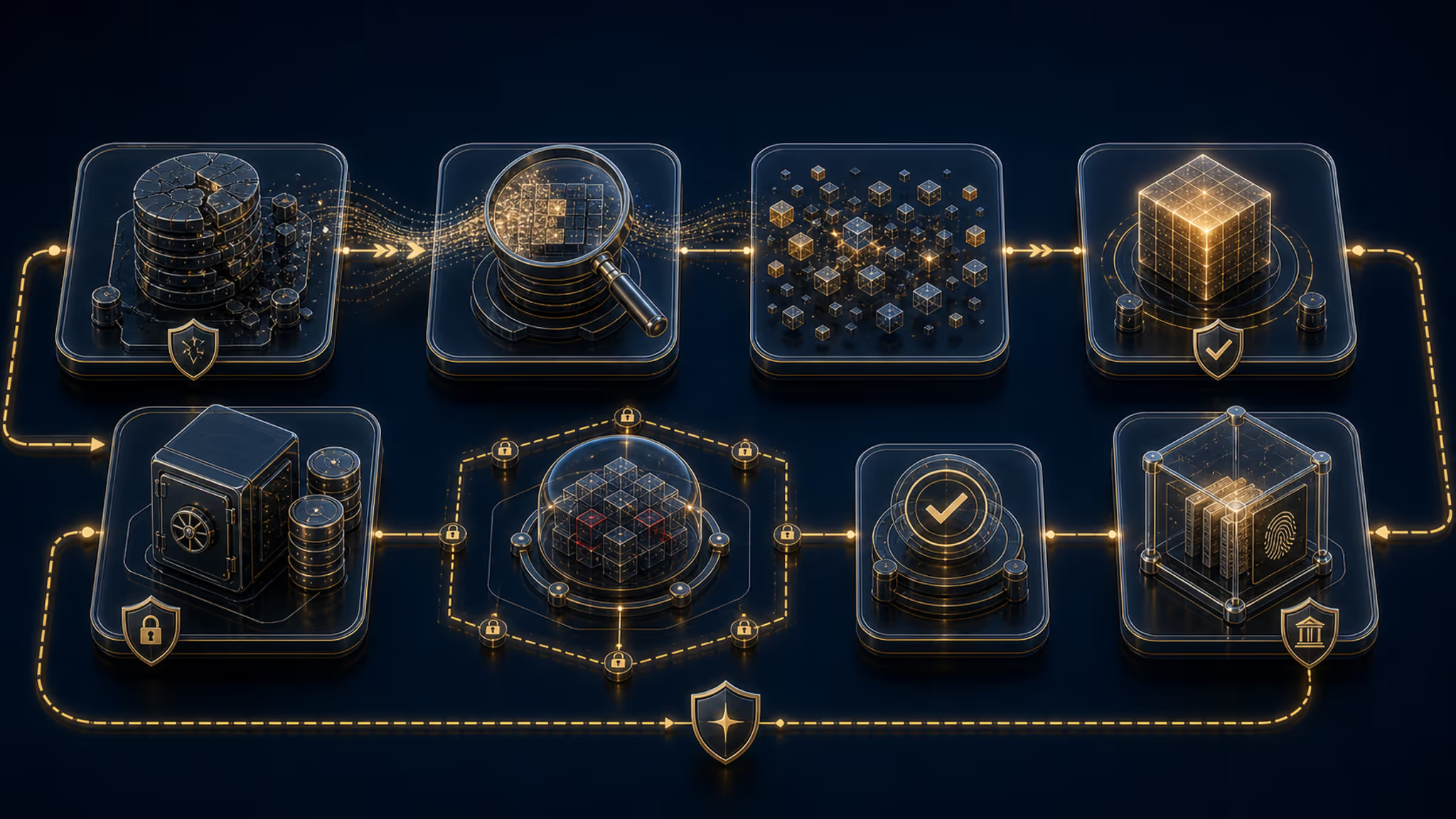
We recover lost data from HDD, SSD, RAID, NAS, SAN, and server systems in a professional lab environment; physical damage, logical failure, and ransomware scenarios are covered.
EVIDENCEISO 22301ISO 27001NIS2Scope record
01Current stateTopology, traffic, and dependency visibility.
02Target architectureSegmentation, capacity, and availability design.
03Controlled cutoverChange window, validation, and rollback plan.
04HypercareMonitoring, tuning, and operational handover.
POSITION
Where this service sits in the portfolio
SERVICE SCOPE
What this service addresses
The critical topics this service addresses and the outcome we deliver in each.
Risk assessment with free pre-diagnosis
evidence readiness
With a free pre-diagnosis taking 1-2 business days for most media and 2-3 for RAID arrays we share the scope and recovery assessment; the result is tied to an evidence record.
Safe handling in a clean room
evidence readiness
We assess physically damaged media in an ISO 14644 Class 100 clean-room environment with techniques such as head swap and platter transfer.
No charge on unsuccessful recovery
contract-scoped
A firm price is quoted after pre-diagnosis; a no-charge-on-unsuccessful-recovery policy is applied as a contract term.
Verified data delivery
measured target
We verify the integrity of recovered data through hash comparison and file-integrity checks and deliver it via encrypted transfer.
Delivery model
Delivery approach
How we phase the service across delivery, governance, and connected service pillars.
01
Pre-diagnosis: with a free pre-diagnosis we inspect the media's condition, share the recovery scope and assessment, and sign an NDA.
02
Laboratory recovery: in an ISO 14644 clean-room environment we perform physical recovery (head swap, platter transplant, firmware repair) and logical recovery (file system reconstruction, partition recovery, RAID rebuild).
03
Verification and delivery: we verify the integrity of recovered data, deliver it via encrypted external disk or secure cloud transfer, and apply secure erasure after the work.
Operating contexts
Example operating contexts
Illustrative surfaces where this service is commonly activated.
Physically damaged media
Organisations seeking a recovery assessment for disks made inaccessible by drops, water or electronic failure.
RAID / NAS / SAN loss
Teams that have lost data on RAID 0/1/5/6/10, NAS or SAN arrays and need laboratory recovery.
After ransomware
Organisations that want to assess alternative recovery methods for ransomware-encrypted data.
DEPTH
Technical and compliance depth
This service's depth on sector-specific technical and compliance topics.
Supported media and environment
We assess HDD (3.5/2.5), SSD (SATA/NVMe), RAID, NAS, SAN and tape media in an ISO 14644 Class 100 clean-room environment.
Ransomware recovery approach
Decryption tools exist for most known ransomware families; for unknown encryption we assess alternative methods such as shadow copy and backup recovery.
Confidentiality and reporting
We sign an NDA and store media in a secure area; with a detailed report covering fault analysis, the operation log and recovery statistics we support insurance and legal processes.
What It Solves
Data loss from hardware failure, accidental deletion, ransomware encryption, or physical damage creates immediate operational paralysis and potential regulatory exposure when backups are absent, outdated, or themselves corrupted. Advanced Data Recovery services restore inaccessible data from the full spectrum of storage media — HDDs, SSDs, NVMe drives, RAID arrays, SAN/NAS systems, and enterprise server storage — even in cases where standard recovery software has already failed. Our ISO-certified cleanroom facilities and proprietary imaging techniques maximize recovery rates for physically damaged media.
Cleanroom-grade physical recovery for mechanically damaged HDDs and SSDs
RAID 0/1/5/6/10 array reconstruction and logical recovery
Ransomware-encrypted volume recovery and decryption key coordination
NAS, SAN, and enterprise server storage recovery (EMC, NetApp, HPE)
Key Benefits
Benefit
Turn the outcome into a measurable target with baseline, owner, and review cadence
Benefit
Make operational speed, resilience, and response outcomes measurable through contracted scope and acceptance criteria
Benefit
Provide no-data-no-fee pricing model, eliminating financial risk for failed recovery attempts
Cleanroom
ISO Class 5 (Class 100) cleanroom for physical media work
RAID Support
RAID 0, 1, 5, 6, 10, 50, 60, JBOD, ZFS, Btrfs
File Systems
NTFS, ext4, XFS, HFS+, APFS, FAT32, exFAT, ReFS
Turnaround
Standard: 5-7 business days; Emergency: 24-48 hours
Scope
Our data recovery scope covers every storage medium used in enterprise environments, from individual workstation SSDs to multi-petabyte SAN arrays and tape libraries. Enterprise engagements include a dedicated recovery engineer, a project manager for daily status updates, and a legal-hold option if data is required for litigation. We work under strict confidentiality agreements and provide chain-of-custody documentation for recovered data, making our service suitable for legal, compliance, and forensic use cases alongside operational recovery.
Dedicated recovery engineer and project manager for enterprise engagements
Tape library recovery (LTO-5 through LTO-9, DLT, DAT)
Encrypted drive recovery including BitLocker, FileVault, and VeraCrypt volumes
Remote recovery for logically failed network-accessible storage
Key Benefits
Benefit
Improve quality indicators through baselines, acceptance criteria, and reviewed evidence
Benefit
Support encrypted volume recovery without compromising organizational security posture
Benefit
Provide real-time recovery progress portal reducing uncertainty during critical incidents
Enterprise Storage
EMC VNX/VMAX, NetApp ONTAP, HPE 3PAR, IBM DS series
iSCSI, NFS, CIFS/SMB logical recovery without physical media shipment
Deliverables
Upon completion of a data recovery engagement, clients receive the recovered data on a verified, encrypted medium of their choice, accompanied by a recovery report detailing the failure diagnosis, recovery methodology, recovered file inventory, and verification checksums. For insurance and legal purposes, we provide a signed chain-of-custody document and a technical expert statement. Failed media is returned with a secure erasure certificate or physically destroyed upon client instruction.
Recovered data on client-specified encrypted medium (AES-256)
Recovery report with file inventory, checksums, and methodology documentation
Chain-of-custody documentation for legal and compliance use
Secure media destruction with certificate of destruction for unrecoverable or sensitive media
Key Benefits
Benefit
Verify data integrity of every recovered file with SHA-256 checksums before delivery
Benefit
Satisfy insurance and legal requirements with signed chain-of-custody and expert statements
Benefit
Eliminate residual data exposure risk with certified secure erasure of all working copies
Output Media
Encrypted external HDD, NAS delivery, secure SFTP transfer
DoD 5220.22-M software wipe or physical shredding with certificate
Frequently Asked Questions
What diagnostic factors affect SSD recovery planning compared to HDD?
SSDs with logical failures such as deleted files or corrupted partition tables are usually more predictable than physically damaged SSDs with NAND chip failure. We provide a diagnostic assessment before committing to recovery, so scope, feasibility, risk, and cost are clear before work begins.
Should I attempt DIY recovery before sending media to a professional?
In most cases, no. Running recovery software on a failing mechanical drive causes additional read cycles that can cause further head damage or platter scoring, permanently destroying data that could otherwise be recovered. If you hear clicking or grinding sounds from a drive, power it off immediately and contact us. Logical failures (accidental deletion, format) are safer to attempt with verified read-only tools first.
Can you recover data from a drive that has been overwritten or reformatted?
Partially overwritten drives may still yield significant data through sector-level analysis, particularly on HDDs where magnetic residue can be detected in some cases. On SSDs, TRIM commands make overwritten sectors unrecoverable. Fully formatted volumes without subsequent writes are recoverable when file-system metadata remains intact through file system metadata reconstruction.
How do you handle the confidentiality of recovered data?
All media and recovered data are handled under a signed confidentiality agreement. Data is stored only in our secure facilities during the recovery process, transferred to the client via encrypted media or secure transfer protocol, and then securely wiped from our systems using DoD 5220.22-M standard erasure. A certificate of destruction is provided upon request.
What if only part of the data is recoverable?
We provide a partial recovery option with a detailed recovered-versus-unrecoverable breakdown before final delivery. Clients can review the recovered file list and decide whether partial delivery meets their needs. Pricing is adjusted proportionally for partial recoveries under our transparent pricing model.
How long is the recovered data retained in your systems after delivery?
By default, we retain working copies for 30 days post-delivery to allow clients to verify completeness before permanent deletion. Extended retention (up to 90 days) is available for complex legal cases. All retained copies are stored in encrypted, access-controlled environments with audit logging, and permanently deleted on the agreed date with a deletion certificate.
Related service groups
Compare the other workstreams under the same pillar as well.