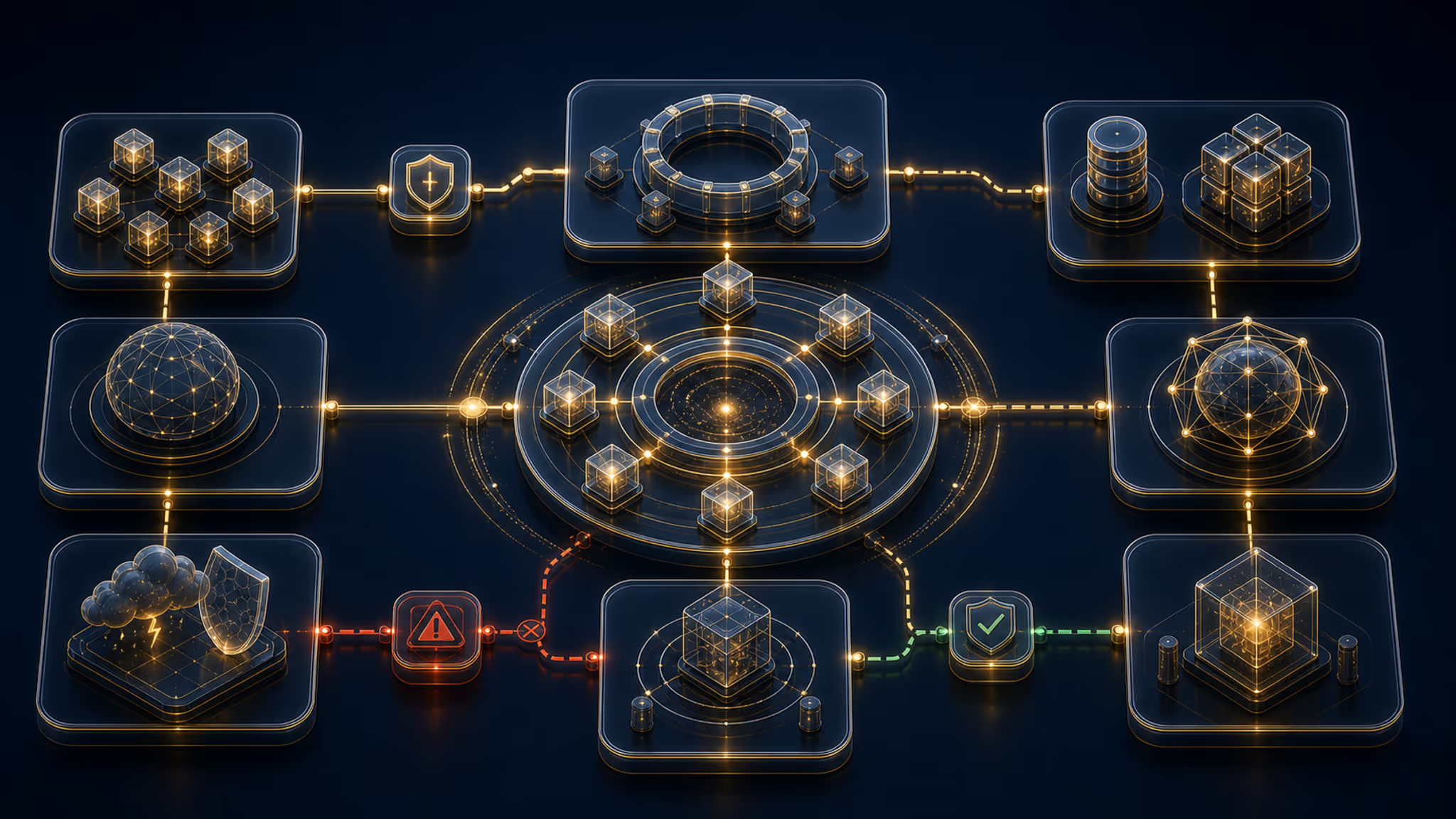
We identify critical processes and acceptable downtime through business impact analysis; a business continuity management system aligned with ISO 22301 goals follows.
EVIDENCEISO 22301ISO 27001NIS2Scope record
01Current stateTopology, traffic, and dependency visibility.
02Target architectureSegmentation, capacity, and availability design.
03Controlled cutoverChange window, validation, and rollback plan.
04HypercareMonitoring, tuning, and operational handover.
POSITION
Where this service sits in the portfolio
SERVICE SCOPE
What this service addresses
The critical topics this service addresses and the outcome we deliver in each.
Critical processes are prioritised
evidence readiness
We map processes, score criticality and derive acceptable disruption windows (RTO/RPO/MTPD) through a business impact analysis (BIA); the output is evidenced in a BIA report.
Alignment with ISO 22301 objectives
published after approval
We align the BCMS with ISO 22301:2019 and BCI Good Practice Guidelines objectives; the certification decision is left to the auditor while we prepare the audit-ready document set.
Recovery validated through exercises
contract-scoped
We validate recovery procedures with tabletop, walkthrough and full-simulation exercises; a minimum of two exercises per year is defined as contract scope.
Continuity targets become measurable
measured target
We make operational uptime and resilience targets measurable through contracted scope and acceptance criteria, tracked with exercise scores.
Delivery model
Delivery approach
How we phase the service across delivery, governance, and connected service pillars.
01
Business impact analysis: through department-level process mapping, dependency analysis and criticality scoring we identify critical processes and acceptable disruption windows.
02
Plan design: we combine risk assessment, recovery strategies (hot / warm / cold site, remote working, cloud DR) and the crisis communication plan into a single business continuity plan.
03
Exercise cycle: we test the plan at least twice a year with tabletop, walkthrough and full simulation, and feed findings into a continuous improvement loop.
Operating contexts
Example operating contexts
Illustrative surfaces where this service is commonly activated.
Undefined disruption targets
Organisations that cannot forecast the cost of downtime because RTO/RPO expectations are undefined.
ISO 22301 readiness
Teams preparing a business continuity management system for certification audit.
Untested recovery plan
Organisations with a written plan whose confidence is weak because it has never been exercised.
DEPTH
Technical and compliance depth
This service's depth on sector-specific technical and compliance topics.
BIA and criticality classification
We derive RTO, RPO and MTPD values through process mapping, dependency analysis and criticality scoring, and capture them in the BIA report.
BCMS document set
We deliver the ISO 22301 compliance file made up of the BIA, BCP, crisis communication plan and recovery procedures in audit-ready form.
Exercises and knowledge transfer
We validate the plan with exercise scenarios from tabletop to full simulation, and enable your internal team to run it independently through training and knowledge transfer.
What It Solves
Organizations face increasing risks from cyber threats, supply chain disruptions, and regulatory pressure that can halt operations without warning. Business Continuity Management (BCM) provides a structured, ISO 22301-aligned framework that identifies critical functions, assesses business impact, and ensures operations can continue through any disruption. Our BCM program eliminates the reactive chaos of unplanned outages and replaces it with tested, documented recovery procedures.
Business Impact Analysis (BIA) across all critical processes
ISO 22301-aligned BCM policy and procedure development
Recovery Time Objective (RTO) and Recovery Point Objective (RPO) definition
Supply chain and third-party dependency mapping
Key Benefits
Benefit
Make risk and response indicators visible through measured controls, rehearsed playbooks, and evidence review
Benefit
Support audit and compliance readiness with evidence records instead of unsupported public outcome promises
Benefit
Make risk and response indicators visible through measured controls, rehearsed playbooks, and evidence review
Standard
ISO 22301:2019 BCMS
Methodology
BIA, RTO/RPO, MTPD analysis
Deliverables
BCM policy, BIA report, recovery plans
Review Cycle
Annual certification audit + quarterly reviews
Scope
Our BCM engagement covers the full lifecycle from initial risk assessment and business impact analysis through plan development, staff training, and certification audit support. We work across all organizational layers — executive leadership, IT operations, facilities, HR, and supply chain — to ensure that recovery plans are operationally realistic and cross-functionally validated. Engagements are structured as fixed-scope projects or ongoing managed BCM programs.
Executive-level risk appetite workshops and BCM governance design
Departmental BIA interviews and criticality scoring
Crisis communications plan and stakeholder notification protocols
Third-party and vendor continuity assessment
Key Benefits
Benefit
Ensure regulatory compliance with BDDK, SPK, KVKK, and sector-specific continuity mandates
Benefit
Make risk, control, and compliance indicators visible through measured targets and evidence records
Benefit
Enable board-level confidence with documented MTPD and recovery metrics
Coverage
All critical business processes and IT systems
Team Access
C-suite, department heads, IT, facilities, legal
Documentation
BCM manual, crisis playbooks, call trees
Integration
Links to DR plans, IT service continuity, and vendor SLAs
Deliverables
At the conclusion of a BCM engagement, clients receive a complete, audit-ready documentation set aligned to ISO 22301 requirements, along with staff trained on their roles during a business disruption. All deliverables are structured for practical use, not shelf filing — plans are tested, gaps are closed, and governance mechanisms are embedded into the operational calendar. Post-engagement, we offer ongoing retainer support for plan maintenance, annual testing, and certification renewal.
ISO 22301-compliant BCM manual and policy framework
Business Impact Analysis report with criticality rankings
Business Continuity Plans (BCPs) for each critical function
Tabletop exercise facilitation and after-action reports
Key Benefits
Benefit
Deliver a certification-ready documentation package within agreed project timeline
Benefit
Shorten operational cycle time against agreed measurement targets and acceptance criteria
Benefit
Provide staff with role-specific response cards reducing confusion during actual incidents
Document Count
15-25 core BCM documents depending on scope
Plan Format
Digital (SharePoint/Confluence) + offline emergency binders
Training
Tabletop exercises, awareness sessions, recovery team drills
Certification Support
Gap analysis, pre-audit readiness assessment, certification body liaison
Frequently Asked Questions
How long does a full BCM program implementation take?
A comprehensive ISO 22301-aligned BCM program is planned through a scoped timeline agreed during discovery depending on organizational complexity, number of critical processes, and existing documentation maturity. We phase the engagement to deliver quick wins within the first 60 days.
Does BCM only apply to large enterprises?
No. BCM is equally critical for mid-market organizations and regulated SMEs. We offer scaled frameworks that match your organizational size, budget, and industry-specific risk profile, including sector-specific templates for manufacturing, finance, and healthcare.
Can BCM be integrated with our existing IT disaster recovery plans?
Yes. BCM is the business-level framework that defines RTOs and RPOs, while DR plans deliver the technical mechanisms to meet them. We integrate both layers to ensure full alignment, eliminating gaps where business expectations exceed technical recovery capabilities.
What industries benefit most from a formal BCM program?
Financial services, healthcare, manufacturing, energy, and public sector organizations face the highest regulatory and operational continuity requirements. However, any organization dependent on continuous IT services, customer commitments, or complex supply chains gains measurable value from BCM.
Who owns and maintains the BCM documentation after the project ends?
Ownership is transferred to an internal BCM owner designated during the engagement. We conduct a formal handover including a BCM owner training session, a maintenance calendar, and a 90-day post-project hypercare period covering questions and minor updates at no additional cost.
How often should BCPs be tested and updated?
ISO 22301 requires documented exercises and reviews at planned intervals. Industry established practice is a full tabletop exercise annually, departmental plan reviews semi-annually, and contact list/dependency updates quarterly. We provide a BCM maintenance calendar as part of every engagement.
Related service groups
Compare the other workstreams under the same pillar as well.