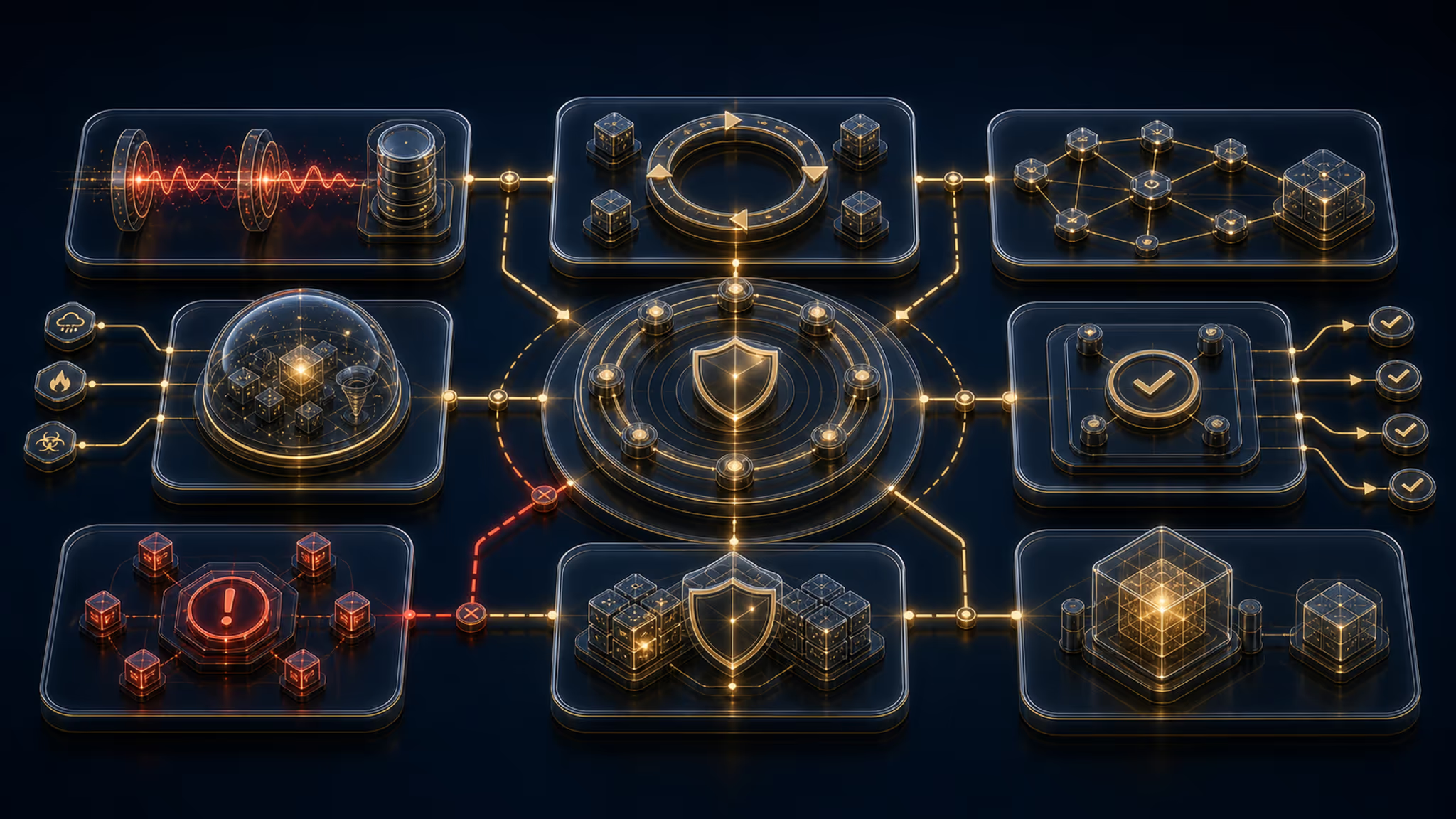
Tabletop exercises, red/blue team simulations, and crisis scenarios measure response capacity; we expose weak points before a real crisis does.
EVIDENCEISO 22301ISO 27001NIS2Scope record
01Current stateTopology, traffic, and dependency visibility.
02Target architectureSegmentation, capacity, and availability design.
03Controlled cutoverChange window, validation, and rollback plan.
04HypercareMonitoring, tuning, and operational handover.
POSITION
Where this service sits in the portfolio
SERVICE SCOPE
What this service addresses
The critical topics this service addresses and the outcome we deliver in each.
Weak points become visible before a crisis
evidence readiness
With tabletop exercises, red/blue team simulations and crisis scenario drills we measure response capacity and make weak points visible before a crisis occurs.
Reflex time shortens measurably
measured target
We measure teams' reflex time with MTTD, MTTR, decision time and communication effectiveness metrics, and track improvement through periodic exercises.
Alignment with regulatory requirements
published after approval
We design exercises aligned with sector regulatory requirements (BDDK, SPK, KVKK); the final compliance assessment is left to the auditor and legal counsel.
90-day tracked action plan
contract-scoped
We assign prioritised action items to Jira/Azure DevOps and track them with owners and due dates over 90 days.
Delivery model
Delivery approach
How we phase the service across delivery, governance, and connected service pillars.
01
Scenario design: we craft the exercise with scenarios specific to the organisation's sector and risk profile (ransomware, DDoS, insider threat, supply chain) and prepare the participant briefing pack.
02
Exercise execution: in tabletop, functional and full-scale formats we accelerate the learning loop with a purple-team approach that runs attack and defence teams together.
03
Assessment and follow-up: against NIST CSF, MITRE ATT&CK and ISO 22301 references we produce a gap matrix, management summary and a 90-day improvement action plan, and track progress.
Operating contexts
Example operating contexts
Illustrative surfaces where this service is commonly activated.
Untested crisis readiness
Organisations with a written plan that have never measured their reaction in a real crisis.
Multi-unit coordination rehearsal
Teams that want IT, legal, communications, HR and senior leadership to work in a coordinated way during a crisis.
Regulatory exercise evidence
Organisations that want to build exercise and action-plan evidence for BDDK, SPK or KVKK audits.
DEPTH
Technical and compliance depth
This service's depth on sector-specific technical and compliance topics.
Exercise types and scenarios
We design tabletop, functional and full-scale exercises with ransomware, DDoS, insider threat and supply chain scenarios from a library of 20+ sector templates.
Purple team and participants
We run IT, security, legal, communications and senior leadership together in purple-team sessions, turning theoretical knowledge into practical experience.
Reporting and certification support
With a gap matrix, action plan and management summary we provide an evidence file for ISO 22301 and SOC 2 Type II processes; the certification decision is left to the auditor.
What It Solves
Crisis plans that exist only on paper provide a false sense of security — the real test of organizational resilience is how people actually behave under pressure, not how procedures read in calm conditions. Cyber Resilience Testing exposes the gaps between documented procedures and operational reality through structured tabletop exercises, red team simulations, and full crisis drills. Organizations discover critical coordination failures, communication breakdowns, and decision-making bottlenecks before a real incident occurs, when the cost of failure is measured in learning rather than operational damage.
Tabletop exercises for cybersecurity, operational disruption, and regulatory crisis scenarios
Red team simulation exercises testing technical and organizational response simultaneously
Cross-functional crisis drills involving IT, legal, communications, and executive leadership
TIBER-EU and CBEST-aligned threat intelligence-led resilience testing for financial sector
Key Benefits
Benefit
Identify an average of 8-12 critical procedural gaps per exercise that would have caused real-incident failures
Benefit
Make risk and response indicators visible through measured controls, rehearsed playbooks, and evidence review
Benefit
Satisfy regulatory resilience testing mandates from BDDK, CMB, and BRSA supervisory frameworks
Exercise Types
Tabletop, functional drill, full-scale simulation, red team
Scenarios
Ransomware, data breach, DDoS, insider threat, supply chain compromise
Frameworks
TIBER-EU, CBEST, CREST STAR, ISO 22301 exercise methodology
Participants
Executive sponsors, IT operations, legal, communications, 3rd parties
Scope
Resilience testing engagements are structured around a four-phase methodology: design, conduct, evaluate, and improve. The design phase develops realistic scenarios tailored to your industry threat landscape and current security posture. During conduct, our facilitators guide participants through the scenario in real time, injecting new injects to simulate evolving crisis conditions. The evaluate phase produces a detailed after-action report, and the improve phase translates findings into updated plans and a remediation roadmap.
Bespoke scenario design based on industry threat intelligence and organization-specific risk profile
Crisis inject management — dynamic scenario escalation to test adaptability
Multi-stakeholder exercises involving external parties (suppliers, regulators, insurers) upon request
Post-exercise remediation roadmap with prioritized action items and owners
Key Benefits
Benefit
Test scenarios drawn from real-world incidents affecting your sector in the past 24 months
Benefit
Ensure cross-functional alignment between IT, legal, and communications teams before a real crisis
Benefit
Meet BRSA Operational Resilience Circular requirements for documented testing evidence
Scenario Sources
CISA advisories, sector ISAC threat reports, recent industry incidents
Inject Types
Technical escalation, media inquiries, regulatory contact, staff unavailability
Every resilience testing engagement concludes with a comprehensive after-action report (AAR) that documents exercise observations, identifies gaps against expected performance, and provides a prioritized improvement roadmap with owners and target completion dates. The AAR is structured for dual use — as an internal improvement tool and as regulatory evidence of tested resilience capability. Exercise materials including scenario packs are retained for use in future self-conducted exercises.
After-action report (AAR) with gap analysis and prioritized improvement roadmap
Regulatory evidence package formatted for BDDK, BRSA, and KVKK examiner submission
Scenario materials and facilitator guides enabling internal re-use and self-conducted exercises
Executive resilience posture summary suitable for board reporting
Key Benefits
Benefit
Produce board-ready resilience testing evidence reducing governance reporting preparation time
Benefit
Enable internal teams to self-conduct quarterly exercises using delivered materials without external facilitation
Benefit
Turn the outcome into a measurable target with baseline, owner, and review cadence
AAR Structure
Executive summary, detailed observations, gap register, improvement roadmap
Regulatory Format
Compliant with BDDK BT Yönetmeliği exercise evidence requirements
30-day and 90-day progress check-in calls on roadmap action completion
Frequently Asked Questions
What is the difference between a tabletop exercise and a red team exercise?
A tabletop exercise is a facilitated discussion where participants walk through their response to a hypothetical scenario at a conference table — it tests decision-making, coordination, and communication without technical execution. A red team exercise involves actual attack simulation by a dedicated adversarial team, testing both the technical security controls and the organizational response to detected (and sometimes undetected) attack activity.
How disruptive are resilience testing exercises to normal operations?
Timeline is confirmed during discovery based on scope, integration complexity, current maturity, and acceptance criteria. The project plan is tied to approved scope and dependencies.
Should legal counsel participate in resilience testing exercises?
Strongly recommended. Many critical decisions during a real incident — breach notification timing, regulatory contact sequencing, public statement approval — require legal input. Including legal counsel in exercises reveals whether legal review processes are realistically fast enough and whether counsel is fully briefed on the organization's systems and regulatory obligations.
Can exercises be designed to test specific regulatory scenarios, such as a KVKK breach notification?
Yes. We design regulatory-specific scenario modules for KVKK breach notification (72-hour VERBIS process), BDDK incident reporting, BRSA operational resilience, and EU NIS2 requirements. These modules walk participants through the exact regulatory steps under simulated time pressure, ensuring the process is tested before it is needed for real.
How do we measure improvement between exercise cycles?
We use a structured maturity scoring framework across five dimensions: detection speed, containment effectiveness, communication quality, decision-making clarity, and regulatory compliance adherence. Each exercise cycle produces scores against these dimensions, enabling direct comparison and demonstrable improvement year over year — both for internal governance and for regulatory evidence.
Can exercise results be shared with our cyber insurer?
Yes, with your authorization. Many cyber insurers now ask for resilience testing evidence as part of policy renewal and premium adjustment processes. Our AAR format includes an insurer-facing summary section that documents tested capabilities, identified gaps, and remediation commitments — information that underwriters use to assess risk quality.
Related service groups
Compare the other workstreams under the same pillar as well.