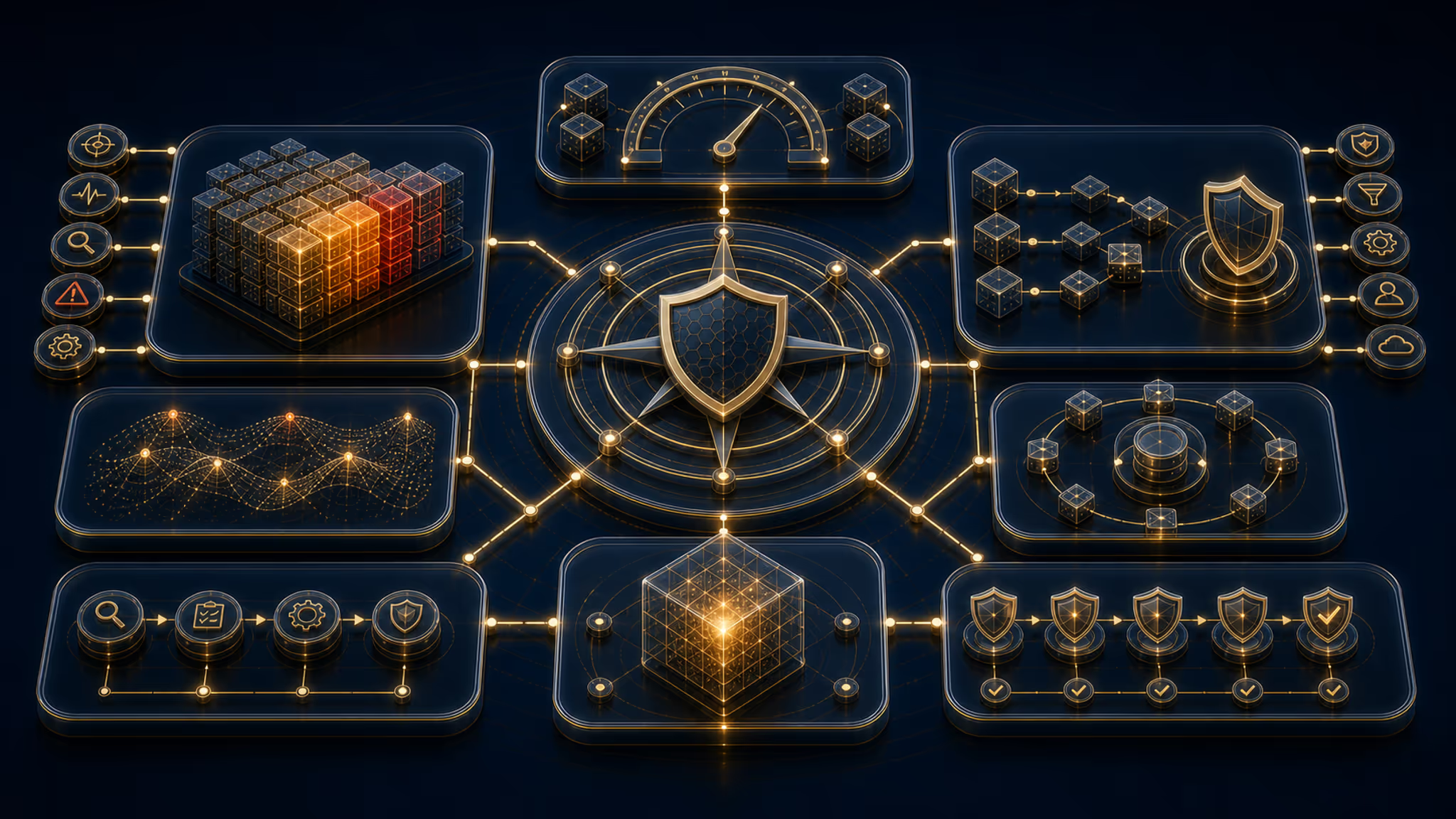
We build integrated risk management on the ISO 31000 framework; departmental, disconnected risk tracking becomes enterprise visibility, and process excellence lifts operational efficiency.
EVIDENCEISO 27001ISO 27701KVKKDORA
01Current stateTopology, traffic, and dependency visibility.
02Target architectureSegmentation, capacity, and availability design.
03Controlled cutoverChange window, validation, and rollback plan.
04HypercareMonitoring, tuning, and operational handover.
POSITION
Where this service sits in the portfolio
SERVICE SCOPE
What this service addresses
The critical topics this service addresses and the outcome we deliver in each.
Enterprise risk view in one framework
contract-scoped
We gather strategic, operational, financial, compliance and reputational risks into a single view under the ISO 31000 and COSO ERM frameworks.
Decision-supporting risk evidence
evidence readiness
With a risk inventory, heat map and KRI panels we produce structured evidence to underpin strategic decisions.
Measurable operational efficiency
measured target
We make the impact of process-excellence projects trackable through a baseline measurement, a target and acceptance criteria.
Risk appetite and ownership decision
published after approval
We document risk-appetite levels through workshops; the final decision on acceptable risk levels rests with the board.
Delivery model
Delivery approach
How we phase the service across delivery, governance, and connected service pillars.
01
We integrate existing risk inventories and assessments into the ISO 31000 framework, filling gaps and resolving inconsistencies.
02
We assess risk through department-level workshops and make operational risk sources visible with BPMN process mapping.
03
We define KRI threshold values and spread risk awareness to every level of the organisation through a champion programme.
Operating contexts
Example operating contexts
Illustrative surfaces where this service is commonly activated.
Fragmented risk tracking
Integrating department-level, independent risk work into a single enterprise view.
Strategic decision support
Strengthening resource allocation and prioritisation by giving the board risk-based data.
Process inefficiency
Turning process inefficiencies that are sources of operational risk into quick wins with Lean tools.
DEPTH
Technical and compliance depth
This service's depth on sector-specific technical and compliance topics.
Risk map and heat map
We prioritise risks with a likelihood-and-impact matrix and ease resource allocation through a heat map.
BPMN process excellence
We map processes with as-is and to-be modelling and run improvement projects with Value Stream Mapping and Kaizen.
KRI dashboard integration
We pull data from systems such as ERP, ITSM and SIEM to compute KRIs automatically and keep trends visible.
What It Solves
Organizations without a structured enterprise risk management (ERM) framework make strategic and operational decisions without understanding their full risk exposure — leading to surprise disruptions, regulatory findings, and suboptimal resource allocation driven by intuition rather than evidence. ISO 31000 Enterprise Risk Management and process excellence frameworks provide the governance structures, risk assessment methodologies, and performance management systems to make risk-informed decisions consistently across the organization. Our ERM engagements connect risk management to strategic planning, ensuring risk appetite is defined at the top and operationalized throughout.
ISO 31000:2018-aligned enterprise risk management framework design and implementation
Risk appetite and tolerance definition with board-level risk governance structures
Process mapping, RACI design, and process performance measurement (KPIs/KRIs)
Business process improvement (BPI) and lean process excellence programs
Key Benefits
Benefit
Turn the outcome into a measurable target with baseline, owner, and review cadence
Shorten operational cycle time against agreed measurement targets and acceptance criteria
Standard
ISO 31000:2018 ERM, ISO 31010 risk assessment techniques
Process
BPMN 2.0 process modeling, lean/six sigma improvement methodology
Tools
GRC platform risk register integration (ServiceNow, RSA Archer, or custom)
Reporting
Risk heat maps, KRI dashboards, board risk committee reporting templates
Scope
Enterprise Risk and Process engagements cover two interconnected capabilities: establishing the governance, methodology, and tooling for risk identification, assessment, and treatment across the organization; and improving the processes through which work is delivered to increase efficiency, consistency, and resilience. These capabilities are integrated because process excellence reduces operational risk, and risk management informs process improvement prioritization. Engagements are structured as strategic programs rather than one-time assessments.
Enterprise-wide risk identification workshops using ISO 31010 techniques (FMEA, bow-tie, scenario analysis)
Risk register design, ownership assignment, and GRC platform configuration
Process maturity assessment and improvement roadmap for priority business processes
Turn the outcome into a measurable target with baseline, owner, and review cadence
Benefit
Make risk and response indicators visible through measured controls, rehearsed playbooks, and evidence review
Benefit
Enable data-driven process improvement decisions using structured performance measurement baselines
Risk Techniques
FMEA, HAZOP, bow-tie analysis, scenario analysis, Monte Carlo simulation
Process Tools
BPMN 2.0, value stream mapping, swimlane diagrams, process simulation
GRC Integration
Risk register APIs, automated KRI data feeds, escalation workflows
Maturity Model
Custom ERM maturity model aligned to ISO 31000 and COSO dimensions
Deliverables
Enterprise Risk and Process engagements deliver an operational ERM framework with populated risk registers, defined ownership, and management reporting structures — not a static document that lives in a compliance folder. Process improvement engagements deliver measured baseline performance data, implemented process changes, and post-implementation measurement showing realized improvement. All deliverables are designed for sustainability: governance structures are embedded, internal owners are trained, and technology tools are configured to support ongoing program execution without continuous external dependency.
Enterprise risk register with categories, owners, ratings, and treatment plans
Board and management risk committee reporting package templates
Process maps (as-is and to-be), improvement implementation plans, and performance dashboards
ERM and process owner training program with competency assessment
Key Benefits
Benefit
Make risk and response indicators visible through measured controls, rehearsed playbooks, and evidence review
Benefit
Turn the outcome into a measurable target with baseline, owner, and evidence review cadence
Benefit
Enable ongoing self-sufficient ERM program operation with trained internal owners and configured GRC tooling
BPMN process maps, SOP updates, training materials, measurement dashboards
Training
ERM fundamentals, risk owner workshops, process improvement practitioner training
Frequently Asked Questions
What is the difference between ERM and project risk management?
Project risk management addresses risks within the boundary of a specific project — on time, on budget, in scope. Enterprise Risk Management addresses risks across the entire organization, including strategic, operational, financial, and compliance risk categories that span multiple functions and time horizons. ERM provides the portfolio-level view that enables the organization to manage its overall risk exposure, not just individual project risks in isolation.
How does ISO 31000 relate to COSO ERM?
ISO 31000 and COSO ERM are complementary frameworks with different emphases. ISO 31000 is a principles-based international standard applicable to any organization and risk type. COSO ERM is more prescriptive and widely used in North American financial reporting contexts, particularly for SOX compliance. We typically recommend ISO 31000 as the primary framework for Turkish and EU-operating organizations, with COSO mapping available for multinationals with North American regulatory obligations.
How do you prioritize which business processes to improve first?
We use a risk-weighted prioritization model that scores processes on three dimensions: strategic importance (revenue/customer impact), risk exposure (frequency and severity of failures), and improvement feasibility (data availability, process stability, change readiness). The processes with the highest combined score become the initial improvement targets, ensuring resources are directed where they deliver the greatest risk reduction and performance improvement simultaneously.
Can process excellence programs coexist with agile delivery methodologies?
Yes. Modern lean and process excellence approaches are fully compatible with agile delivery. We use value stream mapping at the workflow level to identify waste in agile ceremonies and sprint execution, and we apply continuous improvement principles (kaizen) that align naturally with agile retrospectives. The goal is improved flow and reduced failure demand, not bureaucratic standardization that conflicts with agile flexibility.
How do we know whether our risk management program is actually working?
We establish a set of ERM effectiveness metrics at program inception: risk register completeness and currency, KRI breach frequency, treatment plan completion rates, and incident frequency in risk-treated versus untreated areas. These metrics are reviewed in quarterly management reporting and compared against baseline, providing an objective measure of program effectiveness rather than relying on qualitative assertions.
What ongoing support is available after the initial ERM implementation?
We offer three post-implementation support tiers: annual ERM health check (one-day assessment), quarterly retained advisory (monthly check-ins + ad-hoc support), and embedded fractional ERM officer (dedicated part-time risk management resource). The appropriate tier depends on your internal risk management maturity and the ongoing complexity of your risk landscape.
Related service groups
Compare the other workstreams under the same pillar as well.